Refracted Input

Clare O’Farrell’s blog on books, TV, films, Michel Foucault, universities etc. etc.

Posted on my site michel-foucault.com

Le terme de «folklore» n’est qu’une hypocrisie des «civilisés» qui ne participent pas au jeu, et qui veulent masquer leur refus de contact sous le manteau du respect devant le pittoresque…
L’homme est irrevocablemet étranger à l’aurore. Il aura fallu notre façon de penser coloniale pour croire que l’homme aurait pu rester fidèle à son commencement, et qu’il y a un lieu quelconque au monde où il peut rencontrer l’essence du «primitif».

The term ‘folklore’ is nothing but a hypocrisy of the ‘civilised’ who won’t take part in the game, and who want to hide their refusal to make contact under the mantle of respect for the picturesque…
Man is irrevocably a stranger to dawn. It needed our colonial way of thinking to believe that man could have remained faithful to his beginnings and that there was any place in the world where he could encounter the essence of the ‘primitive’. (trans. Clare O’Farrell)

Michel Foucault, (1994) [1963] ‘Veilleur de la nuit des hommes’ In Dits et Ecrits vol. I. Paris: Gallimard, p. 232.

Random thoughts in response
The passage above comes from a personal letter written in 1961 and published in 1963 to Rolf Italiaander. In the 1950s, Itaaliander taught young Congolese in a small village the art of copper engraving inviting them to use it as a form to express anything they liked. Foucault arranged for an exhibition of this art at the French Institute in Hamburg. It would appear that Itaaliander was accused of interfering with the purity of primitive culture by teaching Western technologies of artistic expression.

This remark by Foucault, originally made some 48 years ago now, demonstrates why his work continues to resonate today and draws attention to his radical rejection of any social Darwinist ideas of human cultural evolution.

There is no hierarchy of human culture either in terms of its historical or its geographical location. We are never any closer to some pure point of authenticity and truth. Human culture is already an interpretation of the world from its very first moments. One cannot buy into the romanticism of the primitive – which is assumed to be so much closer to pure truth and ‘nature’. Conversely one cannot make the colonial assumption that one civilisation or one period of history (now) is more advanced and more evolved than another. As Foucault remarks elsewhere, we are limited beings and we cannot occupy the whole territory – we can only move around on it in our attempts to make the physical and social environment workable for us.

This point of view immediately irons out all pretensions to the claims of superiority by one group of humans (either historically or geographically) in relation to another and allows for lines of mutual respect and openness to be constructed. It also addresses the false tolerance with which we are incited to treat other cultures even if they operate savage and oppressive practices against their own members. I am thinking here of practices such as female circumcision which somehow survive intact even if other cultural practices within that community inevitably change (usually to advantage men) with Western contact.

If we regard all human culture – without exception – as a complex way of dealing with the environment and social interaction, then we all have an obligation not to dismiss certain intolerable practices as quaintly folkloric simply because they are not part of our own ‘culture’, but to work with other human communities to modify the way human beings treat each other everywhere. From the Western point of view, this does not mean engaging in the patronising paternalism of an allegedly more enlightened Western culture (along the lines that ‘Western democracy will save the world’ for example). Neither, on the other hand, does it mean the rejection of a corrupt and over-civilised Western culture which has lost touch with its primitive roots.

Tarot's padMy rating: *****
The Ace of Wands website
See here for my main post on this series.

I am enjoying my repeat viewing of the series and finding it a lot less clunky second time around. Nonetheless the hilarious difference between the shots of the cast on donkeys in a sandpit with a tame camel tethered in the background and the stock shots of Egypt still makes me laugh.

Another enjoyable thing about the series includes the very 60s/early 70s theme song (composed by Andrew Bown, a future member of Status Quo with lyrics by Trevor Preston) which are the absolute embodiment of meaningless 60s psychedelia.

Velvet roofs
Tattooed streets
Patterns made from words
Laughter echoes in the dark
Life hovers like a bird

This song accompanies a psychedelic animated sequence which is an equally classic period slice.

The endings of all the stories remain a bit of a let down with interesting supernatural themes being swept under the carpet by so-called ‘rational explanations’ or simply being too hastily and abruptly resolved. In P.J. Hammond’s stories one can see the embryo of many of the ideas he went on to develop much more fully and more satisfactorily in Sapphire and Steel. It is a pity that Hammond hasn’t in general had more opportunity to work in the supernatural/fantasy genre where he is able to generate unique and striking ideas conducive to further philosophical reflection. Instead most of his work has been in crime fiction with a number of outings in recent years in Midsomer Murders, a modern entry in the English country village murders genre à la Agatha Christie.

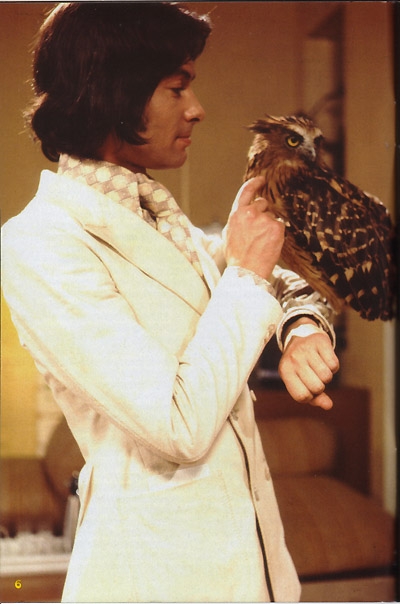
The acting is good all round in Ace of Wands and there is a warm friendly cameraderie between the three members of the main cast which makes for easy repeat viewing. And of course the fashion and the pet owl add to the ongoing aesthetic fascinations.

It has prompted me to think about doing a comparison with other series featuring stage magicians (eg Jonathan Creek and Bill Bixby’s The Magician) and I might write something about those further down the track.

My other posts on Ace of Wands
Ace of Wands (1970-72)

Links to other pages on Ace of Wands
The Ace of Wands website
David Sheldrick
Geoff Wilmmetts
Andrew Screen
Review on the Retro to go site

Mondo Esoterica Review
BFI screenonline page Includes video clips
Pages at Clivebanks.co.uk

Tarot

This post was updated 24 April 2014

My rating: *****

Note: Simon Coward’s comprehensive, but now defunct, Ace of Wands website (available in the Wayback machine internet archive) and Andrew Pixley’s copious viewing notes which accompany the 2007 Network DVD release have been invaluable in providing background information and quotations for this review.

This British children’s fantasy series is by all current technical standards fairly dire. It is slow, there are noticeable differences between filmed exterior shots, archive stock footage and videoed interior shots as well as glaring continuity errors and booms in shot. The special effects induce hilarity rather than wonder or horror, there are gaping plot holes and dialogue is sometimes stilted. Yet one reads enthusiastic review after review of this series – all of them recent – on the web. Perhaps, it might be argued, that these represent nothing but the rose coloured reminiscences of the legion of nostalgia buffs out there. Yet there are people new to the series, seeing it for the first time (it was made available on DVD in 2007) who are equally keen, even if one admits that those buying such a set are already a specialist audience amongst specialist audiences.

When I first started watching the DVDs I found the stories hideously slow and unconvincing. The special effects (shaking rooms and floating Egyptian artefacts) and faux location shots in quarries were entertainingly amusing rather than gripping. Neither am I a fan of borderline pantomime villains of the type found in The Avengers and the later series of classic Dr. Who. But by the end of the series I was completely hooked. So what happened, what drew me in and kicked all my fan mechanisms into gear? But before talking about that let’s provide some background on the series first.

Ace of Wands is a children’s fantasy series originally broadcast by Thames Television from 1970 to 1972. The central figure, Tarot, is a highly successful stage magician and illusionist who, dressed in the height of early 70s fashion and with the help of two assistants/friends (one male, one female), investigates and solves weird goings on. His pet owl, Ozymandias, although not of any practical help in these proceedings, provides moral and aesthetic support.

Three seasons of the series were made and in the historical and cultural vandalism that marked television policies of the 1960s and early 1970s, the first two seasons were wiped by the television company who were out to save money by reusing old videotape. Little did they realise that some thirty years down the track this would be a more than false economy, and that they had unwittingly deprived themselves of a goldmine. There is a lesson in there somewhere. Fans continue to scour the world in the hope that, as with Dr. Who, copies will be found secreted away in the archives of some less irresponsible television station outside the UK.

If these first two seasons ever do come to light, one thing I would particularly like to see is Tarot’s minimalist and futuristic Japanese style warehouse flat. For some inexplicable reason, in season 3 he is moved to a houseboat. I have a serious weakness for futuristic white minimalism and can only see a houseboat as a backwards step in this context.

Perhaps the secret of the series, and what finally engaged my fan interest is the conceptualisation of the central character and Michael Mackenzie’s performance in this role. Indeed the acting all round, of both principals and villains, is very solid which helps make up for other shortcomings. Mackenzie explains the considerable success of his character with the audience at the time, which included not only children but large numbers of university students. Tarot was, he says, ‘a really good looking bloke in attractive trendy clothes of the time – someone the girls like. For the boys he has a pet owl, fast cars and motorbikes’. One might remark, however, that this statement in relation to gender preferences is perhaps unduly limiting. Not a few girls, then as now, tend to look favourably on a man who accessorises himself with fast expensive cars and an animal as exotic as an owl.

In an interview with Simon Coward Mackenzie further remarks on his approach to the role:

I had no idea what I was doing at first, apart from making sure that I looked good in the trendy clothes, fast cars and beautifully designed sets! I thought he should convey the impression of great inner strength and mental and spiritual development but be relaxed. But basically I was so inexperienced I thought it was best to do what I was told by the directors.

He notes elsewhere, ‘I think Tarot is a rather reserved and mysterious person’. In fact we have no background information on Tarot at all and he seems to possess vaguely paranormal powers. A character like this is usually played with a degree of coldness and remoteness, but Mackenzie as well as admirably succeeding in conveying all the character traits he lists above, opts for a warmth and humility which nonetheless, as he says himself, doesn’t preclude Tarot from being a bit of a ‘smartarse’. It is perhaps telling that Mackenzie prefers the episodes penned by P.J. Hammond (of future Sapphire and Steel fame) where Tarot is under genuine threat from adversaries who are far stronger than himself.

There is also a good deal of chemistry between Tarot and his friend Mikki and also it would seem from remarks about the earlier two series, between Tarot and her predecessor Lulli. Nothing is ever stated but perhaps the actors decided that in real life, in non-television land, two people who shared an unusual telepathic link, who embarked on numerous adventures together and who both shared a love of 70s fashion would inevitably get together. We notice Tarot and Mikki flirting quite outrageously sometimes and a discreet physical contact between them that would seem to indicate that offstage in uncensored reality, something was going on that couldn’t be dealt with up front in an early 70s children’s series. Further, as Michael Mackenzie indicates, Tarot had to be seen to be available and unattached to maintain the attention of the female viewing public.

Personally, I have never really understood this argument which is frequently advanced in relation to the depiction of male leads in TV series. From my own point of view, I find it far more interesting to see how my male heroes deal with attachment rather than avoid it or fail to achieve it. It would seem for all these prohibitions, however, that the actors manage to slip the hint of a relationship under the radar and in between the lines. In the DVD commentary tracks Mackenzie and Petra Markham (who plays Mikki) refer to the problematic nature of the undefined relationship in the script, and joke about the flirting between the characters but say nothing about the choices they made in playing the roles at the time.

If Judy Loe (Tarot’s first female ‘assistant’) left the series at the end of season 2 justifiably fed up with, as she says, ‘being allowed some intelligence, but always having to be rescued by the man’, her replacement was given more character scope and freedom. Mikki although sometimes a bit airy fairy and impulsive frequently gets Tarot out of trouble and occasionally initiates an adventure herself (‘The Beautiful People’). It is her brother Chas (Roy Holder) who is the one who usually needs rescuing. This change may have been due to writers such as P.J. Hammond taking over more script control as Trevor Preston, the originator of the series, started to move on to other projects. P.J. Hammond, of course, was to go on to write a wonderful female role (greatly aided and extended by Joanna Lumley’s uncompromising approach) in Sapphire and Steel.

The character of Tarot shares much in common with his contemporary Jon Pertwee’s Doctor in Dr. Who. Both characters have a love for flamboyant 70s fashion – although Tarot’s wardrobe is far more extensive and expensive (!) than the Doctor’s. Both use their wits and intelligence to fight adversaries, even if they can both be irritatingly secure in the conviction of their superior knowledge. Both have mysterious origins – Tarot perhaps more so, as at least we know that the Doctor is an alien from another planet. Both characters also display a warmth and a sympathy towards those around them – even if the Doctor demonstrates an irascibility and impatience that we never see in Tarot. Likewise (unlike David Tennant’s Doctor), they are not willing to condemn their opponents to oblivion. The Doctor is devastated when Unit blows up the Silurian stronghold, Tarot recognises ‘Mama Doc’s’ behaviour as the result of mental illness and arranges some discreet intervention after he has dealt with the main problem. Both characters are also linked in with the ambient early 1970s cultural interest in the ‘mystic East’ and the then trendy interest in the paranormal, the ‘mystical’ and the ‘occult’. These cultural tropes went on to be read very differently in the 1990s during The X Files period.

Most unfortunately, after season 3, in spite of excellent ratings and no sign of a wane in popularity, the series was cancelled, ending on a sudden cliffhanger. The cancellation was due to a change in the directorship of children’s programming at Thames and the series was replaced with the arguably inferior and less subversive The Tomorrow People. One can only speculate on what the series might have become with a couple more seasons, but like so many other promising shows that have been cancelled, we will never know.

The other attraction of Ace of Wands for current viewers is that it is a concept (good looking, mysterious and stylish stage magician investigates weird things with his friends) which still holds up very well today and in this age of the remake and the ‘reboot’, a reactivation of this series could go down very well indeed. (Hint, hint to any program developers out there).

My other posts on Ace of Wands
Ace of Wands (2)

Links to other pages on Ace of Wands
The Ace of Wands website – now defunct but still archived on the Wayback Machine
David Sheldrick
Geoff Wilmmetts
Andrew Screen
Review on the Retro to go site

Mondo Esoterica Review
BFI screenonline page Includes video clips
Pages at Clivebanks.co.uk

I believe solidly in human freedom.

Michel Foucault, (2000) [1984]. Interview with Actes. In Power. J. D. Faubion (Ed.). Tr. Robert Hurley and others. New York: The New Press.

An interesting comment in response to my reflections on the Foucault quote for May has prompted me to add these further remarks.

Since the early 1980s Foucault has been criticised – particularly by sociologists and also by Habermas et al for not having a theory of ‘agency’. Quite apart from indicating an inability to think outside the boundaries of a certain way of conceptualising the world, this criticism also indicates an ahistorical reading of Foucault’s work. If in his earlier work he doesn’t discuss in detail the interiority of the way people made decisions about action, his work is all about showing that these decisions were not inevitable and that the current configuration of culture is not the result of some pre-determined process. Quite the contrary in fact. There is a good deal of accident, chance, and petty politicking which operates in any situation making its outcome unpredictable. [1]

Even if the historical systems of order Foucault describes necessarily limit the action of those located within those systems, there is always room for resistance and change even if change sometimes comes at a high individual cost. Foucault is always interested in describing a specific historical situation – not how things are at some eternal level. This historicity means that systems of order cannot be absolutely determining. Such systems are the complex result of a myriad collection and interaction of human actions in every arena of human activity, not the result of a conspiracy exercised by a few or by some mysterious ahistorical force.

Foucault’s work proliferates with examples of his fundamental belief that things can be changed for the better in specific situations. But what differentiates him from some other grand theorists is that the course of action he proposes is not simple or reductionist. There is no quick fix and no magic bullet which will solve for once and for all the ills of the world. This is perhaps what frustrates people who are looking to his work for some overall advice on what they should do. Instead Foucault proposes constant and daily work in the realm of thought and of action, to be undertaken by each individual in the quite specific circumstances in which they find themselves. There is no end to this work as new situations and problems are constantly arising. He notes:

that it is a question of constructing not a system but an instrument: a logique appropriate to power relations and to the struggles taking place around them…
this research can only be done step by step, on the basis of a reflection (necessarily historical in certain of its dimensions) on given situations. [2]

He is also happy for his work to provide ‘tools’ which people can use to construct their own ways of implementing postive change. As he says further

All my books, The History of Madness or Discipline and Punish are, if you like, little tool-boxes. If people want to open them, use a sentence, an idea, an analysis as a screwdriver or a spanner in order to short-cicuit, disqualify and break systems of power, including if need be, those which have given rise to my own books, well, so much the better! [3]

This and Foucault’s constant insistence on the historicity of all systems of order would seem to counter arguments positing a determinist approach in his work. Further, Foucault is not suggesting an overall plan but rather a piecemeal approach tailored to the situation in hand.

Human beings, in Foucault’s view, are by no means determined by the historical and cultural circumstances in which they find themselves. As he says elsewhere he ‘believes solidly in human freedom’ [4] defining that freedom as a practice of making choices, not as a distant goal. Foucault is not interested in providing an easy template for universal application. Indeed, he doesn’t believe it is possible to do so. But he is interested in people making use of their ability to choose, in order to use his work as a tool (amongst others) to undermine intolerable systems and practices of power.

[1] See Foucault. (1994) [1971]. Nietzsche, la généalogie, l’histoire. In Dits et écrits, Paris: Gallimard, t. II, p. 141.

[2] Foucault, (1979). Power and Strategies, in M. Morris & P. Patton (Eds.), Michel Foucault: Power, Truth, Strategy, Sydney: Feral Publications, p. 57.

[3] Foucault [1975]. Des supplices aux cellules. In Dits et écrits, Paris: Gallimard, t. II, p. 720.

[4] Foucault, (2000) [1984]. Interview with Actes. In Power. J. D. Faubion (Ed.). Tr. Robert Hurley and others. New York: The New Press.

My rating: *****
Spoiler alert


imdb link

This wonderful and underrated science fiction film was directed by Vincenzo Natali who directed the earlier better known Cube. The original title for the film was Company Man but was renamed Cypher when the film-makers found there was another film of the same name.

Cypher means a person of no influence, zero or nothing. It is essentially a film about identity, the homogeneity of modern life and rather surprisingly a love story, although this is not apparent until the end. The satisfyingly convoluted plot by Brian King involves a colourless corporate employee Morgan Sullivan (Jeremy Northam) who agrees to become a spy with the pseudonym Jack Thursby for his company Digicorps who are locked in a battle for corporate domination with another megacompany called Suncorps systems. In a plot twist we find that the boring conventions that Sullivan is supposed to be secretly recording around the country are in fact brainwashing sessions in which he is given a new identity as an another equally colourless company man also living in bland suburbia trapped in an identical loveless marriage. Along the way Sullivan meets a beautiful woman Rita Foster (Lucy Liu) who helps him through these convolutions. We also find out about a mysterious super spy with the intriguing name of Sebastian Rooks.

The production design and art direction in this film is outstanding. Colours are carefully and subtly arranged throughout the film. The plays of light and shadow over the characters and their faces is beautiful to watch. The sets are also wonderfully futuristic but redolent of the 1950s and 1960s. The story takes place in a futuristic retro environment where it is permanently the 1950s, but technology has rendered that bland comformity into an even more repressive and homogenised environment. The film begins in a virtual monochrome with gradual subtle departures like a book about the South Sea islands owned by the main character and a glass of single malt whiskey being poured. Walter Mitty like, Sullivan creates a fantasy about himself in his new character as Jack Thursby as having been born in the South Sea islands and being a lover of fine whisky, cigarettes and golf.

What is so satisfying is that at the end it turns out that the extravagant fantasy is actually the reality. Sullivan is in fact Sebastian Rooks who has changed himself via brainwashing into the corporate man in order to steal a piece of data from a high security vault. We speculate about what piece of data could warrant such extravagant preparation and risk. Then we learn at the end that it is a file on his lover Rita Foster with the directive ‘terminate with extreme prejudice’. As they sail away on their yacht he tosses the disk – the only copy of the data – into the sea.

The film closes on a beautifully lit and framed closeup of Sebastian Rooks looking utterly different from the bland Morgan Sullivan. The shot is underscored with electronic lounge music that is quite different and just as right as the austere music that accompanies the rest of the film. It is a brief shot that I can watch again and again just to enjoy its sheer enigma and mystery. As Natali says in the director’s commentary, we can never know who anybody is, not even ourselves.

Incidentally, the sense of dream like strangeness and displacement that the film creates is helped by the fact that although set in the USA, this is a Canadian film and only one of the actors Lucy Liu is American. Jeremy Northam is British and the director, crew and all the other actors are Canadian.

Although there has been some controversy about the ending of the film and the contents of the disk, in my view it is the most satisfying ending possible and completely makes the whole film, for me at least. Rooks’ quixotic and anarchic gesture of romantic love is the perfect counterpoint to the ruthless greed of the corporations and completely negates what they stand for. Further to this, reality is not the usual cold shock of the boring mundane, but the fantasy of colour, luxury and freedom.

My one criticism of the film would be Rita’s removal towards the end, of her red and beautifully styled short wig to reveal her long black hair. This reduces her character to ordinariness just as Morgan Sullivan remembers himself as the very exotic Sebastian Rooks. I would have far preferred Rita Foster to retain her cool stylishness to match his.

Watching this film the first time around one certainly doesn’t see the final twist coming. On a second viewing of the film, one can appreciate it as a love story. Jeremy Northam’s subtle transformation from a colourless and unattractive cypher to an enigmatic, dangerous and attractive man is quite an acting tour de force.

Posted on my site michel-foucault.com
See here for additional discussion.

Didier Eribon: On vous dit assez pessimiste. A vous entendre je vous croirais plutôt optimiste?
Il y a un optimisme qui consiste à dire: de toute façon, ça ne pouvait pas être mieux. Mon optimisme consisterait plutôt à dire: tant de choses peuvent être changées, fragiles comme elles sont, liées à plus de contingences que de necessités, à plus d’arbitaire que d’évidence, à plus de contigences historieques complexes mais passagères qu’à des constances anthropologiques inévitables.

Michel Foucault, (1994) [1981] ‘Est-il donc important de penser?’ In Dits et Ecrits vol. IV. Paris: Gallimard, p. 182.

Didier Eribon: You are said to be rather pessimistic. Listening to you, though, I get the impression that you are something of an optimist instead.
There is an optimism that consists in saying, “In any case, it couldn’t be any better.” My optimism would consist in saying, “So many things can be changed, being as fragile as they are, tied more to contingencies than to necessities, more to what is arbitrary than to what is rationally established, more to complex but transitory historical contigencies than to inevitable anthropological constants…”

Michel Foucault, (2000) [1981] ‘ So is it important to think? ‘. In J. Faubion (ed.). Tr. Robert Hurley and others. Power The Essential Works of Michel Foucault 1954-1984. Volume Three. New York: New Press, p. 458.

Random thoughts in response

Foucault has frequently been accused of being a destructive and dangerous nihilist. There are a number of reasons for these accusations. The first perhaps, is that he offers a point of view on political and social action that diverges from the positions of those making the accusation. On the doctrinaire Left, he is seen as a nihilist because he doesn’t have a grand schema of revolutionary action or of desirable personal identities that can offer a solution to any and all social problems. The claim is that this gives people nothing to aspire to and they can only sink into despairing inaction.

On the doctrinaire Right, he is a nihilist because he radically questions the existing status quo and suggests that existing structures of power and authority might not be all sweetness and light and have the best interests of everybody at heart.

But if one is prepared to leave such partisan doctrines aside, Foucault’s work offers a whole range of possibilities. He systematically shows that structures and ideas we think are immutable have in fact changed over time and indeed haven’t always existed. He shows that the most miniscule of changes are important and that every person is in the position to effect some kind of change at some level in a highly complex social and cultural arrangement.

Foucault’s work is in fact endlessly optimistic. No matter how bad any situation is there are always possibilities for change, for making choices, no matter how restricted. A problem is simply an invitation to consider what might be done, what strategies can be employed to create even a subtle shift. At present, the tendency is to create social and cultural relations that are more and more legally and bureaucratically restrictive, tied down with endless rules and regulations. The game becomes a quest to find the loopholes, the points of weakness, the empty spaces that are not covered by these networks of regulation.

Admittedly, in the current historical situation this quest for loopholes of freedom is becoming more and more difficult – and I am thinking of my own local institutional space which is the university. But times have always been hard. As Foucault points out there is no such thing as a golden age when all was rosy. Perhaps current difficulties are no more than an incentive to think harder about where those heterotopic spaces might be found and an invitation to have the courage to seek them out, set up new alliances and not succumb to the temptations of power and status which the institution appears so enticingly to offer (for a price). As Pierre Bourdieu has so acutely observed, institutions count on their members buying into their exclusionary hierarchies, taking the gamble that they might be rewarded with entry into that exclusive and miniscule club of people who manage to get to the top.

Cornelius Castoriadis points out that all social institutions have a tendency to be totalising. It’s more efficient, and human populations can be messy and disorganised. But it is only because people resist and object to these totalising tendencies in all sorts of ways that means that existence is not absolutely intolerable. But resistance needs to happen. Individual stands need to be taken against cultures of fear and the seductions of power – even if those stands are quite obscure and quite mundane, a laugh in the tearoom or at a staff meeting perhaps, a failure to fill in some tedious form.

This is where Foucault’s optimism comes in. There is always room for movement somewhere. Reading his work is a constant and encouraging reminder of this.

Posted on my site michel-foucault.com

‘Je suis un expérimentateur, et non pas un théorician. J’appelle théorician celui qui bâtit un système général soit de deduction, soit d’analyse, et l’applique de façon uniforme à des champs différents. Ce n’est pas mon cas. Je suis un expérimentateur en ce sens que j’écris pour me changer moi-même et ne plus penser la même chose qu’auparavant.’

Michel Foucault, (1994) [1980]. Entretien avec Michel Foucault. In Dits et écrits, t. 4. Paris: Gallimard. #281, p. 42.

‘I am an experimenter and not a theorist. I call a theorist someone
who constructs a general system either deductive or analytical, and
applies it to different fields in a uniform way . This isn’t my case.
I am an experimenter in the sense that I write in order to change
myself and in order not to think the same thing as before’

Michel Foucault, “Interview with Michel Foucault” J. Faubion, ed., Power (New York: New Press, 2000), p. 240.

Random thoughts in response

Foucault is often either revered or feared as a ‘theorist’. ‘Theory’, the bane of undergraduates loathe to strain their brains, and the dreaded holy grail of postgraduate students looking for some way to satisfy their supervisors’ unreasonable requirements to organise their empirical data into some meaningful form. In the 1970s, 1980s and even the 1990s ‘theory’, particularly in its French, German and Italian incarnations was the object of aspiration: exciting, difficult and mysterious. Its practitioners were much admired for their lofty intelligence and ability to explain the world and perhaps change things for the better as a result. Alternately, of course, they were reviled as a bunch of obscurantist and dangerous radicals exerting a pernicious influence on the young and foolish.

But the new millennium has seen the erosion of the high status of theory. University courses have systematically eliminated this kind of reflection in favour of pragmatic, so-called ‘vocational’ concerns. That’s what the ‘market’ wants. In vocational courses such as teacher training – the suggestion that reading of reasonable difficulty might actually take place outside of class time and then be discussed in said class, leads to either sullen resistance or open hostility and poor ‘student evaluations’ of the course. The client is always right. Yet paradoxically, many people (even undergraduates) still have a creeping suspicion that there must be more to life and social existence than learning how to conform to ever more oppressive work-place regulations or propping up the economy in this time of GFC (global financial crisis. I will pass on the sheer utter pomposity and Sartrean bad faith of reducing this to an acronym). In desperation, many people, faute de mieux, turn to that nineteenth-century mechanism of social control, psychology, only to find the dreary parade of rats and stats, pseudo-scientific jargon and statements of the obvious has advanced them no further.

Further, postgraduate students in vocational areas such as education bemoan in mantra-like fashion the fact that they have been given no proper training or exposure to ‘theory’, which once they start reading, they actually find to be of some interest in organising interpretations of the world and events.

But, of course, Foucault claims not to be a ‘theorist’ in spite of universal insistence to the contrary. This further confuses students and a number of academics who see theory as little more than a grid or template, inexplicably insisted on by supervisors and journal referees for slotting empirical data into convenient boxes. Foucault’s work can’t really be adequately used as a template – although some interpreters have taken aspects of his work and produced handy digest forms for such use.

Foucault’s work is an approach, not a formula for the easy cataloguing of data. His point of view is that we are profoundly historical beings who produce forms of knowledge that are also governed by history. The next step is to describe these historical orders, and history by definition involves constant change. There can be no universal ahistorical template of order. Each historical situation requires reflection and investigation in order to discern the patterns of order which emerge, and further, these patterns of order vary according to the level being examined – are we talking about ships entering a harbour, scientific medical theories, economics or political reform? In a given period, these can all be related at various levels but they have to be examined in turn and the connections between them drawn. This is not a recipe for the production line organization of data and its easy filing into suitable catalogue drawers, drawers which can then be hastily closed and readily forgotten.

II
A comment on this post raises the question of the relation between ‘theory’ and everyday life. I have posted my response here to give it more visibility.
The answer to this question depends on how you define the relation between the kind of reflection that Foucault offers and day-to-day activity. I don’t believe in theory/practice divides. So-called theory is already a practice. The way one thinks about the world is fundamental to how one lives in the world.

For example, if you believe that men are superior to women and that one ‘race’ is superior to another, or that money and status are what count and have a whole set of ideas to support those beliefs – this will determine how you act in the world. If, however, you change your mind about these beliefs after reading some books or having been exposed to these books through education, you are (perhaps) going to behave differently.

It is not a question of abstract tools (‘theory’) which can somehow be applied to deal with specific problems in the so-called ‘real world’ (practice). This is not what Foucault’s work is about. As I’ve said above – he’s not offering a template. It’s about challenging beliefs people might have about the way things work. It is then up to people reading books such as Foucault’s to decide what they want to think about it all and to decide in what ways they want to conduct themselves at an everyday level in their own very specific situations.

In short, as Foucault said himself elsewhere, a ‘theory’ is not the answer. It is only one element – but a non negligeable element – in a complex equation. And being exposed to ‘theories’ gives one more choices in the ways one thinks about the world and therefore interacts with it.

My rating: *****
See my other post reflecting at more length on Sapphire and Steel

Sapphire and Steel is my favourite science fiction series and I have watched quite a few. Starring the blond duo Joanna Lumley and David McCallum, it was broadcast in Britain from 1979 to 1982 and then, like the characters at the end of the series, assigned to oblivion. Precious, but poor quality tapes circulated amongst the fan community for some years after that: the snowy lack of picture definition and the muffled sound only adding to the mystery. I purchased the VHS tapes which were released in 1992 in the late 1990s, and then the later two DVD releases in the first decade of the new millenium.

The premise is that Sapphire and Steel are two non human agents who arrive from somewhere that is never specified. Their job it is to maintain the integrity of the flow of time which is all too often under assault by malevolent forces. The destruction of the integrity of time can have disastrous and final consequences for life on earth.

My interest in the series is not fueled by nostalgia which is often the case amongst the viewership of older cult TV series. I didn’t see the series when it first came out. I first came across it in the late 1990s and watched it then in an endless loop. Ten years later, I find myself once again absolutely rivetted by its minimalism, by the chemistry between the two attractive leads and the sheer unexplained mystery of some of the events and actions of the characters.

If the series moves at a slow pace by current standards, this merely builds the very considerable atmosphere of menace and danger and allows one to study the character interactions at leisure. The effects were achieved with creative effort and ingenuity rather than with the blithe facility of some current CGI effects. As the director Shaun O’Riordan points out – this gives the series a weight that comes from that investment of creative invention.

I have been watching the 2008 re-release of the series which is quite an improvement in quality over the earlier DVD release. It also includes a documentary which puts together a series of interviews with the director producer Shaun O’Riordan, the writer PJ Hammond – who writes with a truth that comes from the heart and utter conviction – and McCallum and Lumley. All involved in the series – crew, actors, director, writer – were passionate about it and did their very best work and all came up with creative ideas which enhanced the series. The lighting, camera work, special effects, sound and music are all noteworthy in creating the very unique atmosphere of this series.

It is evident from the documentary that those involved remain intensely and genuinely proud of their work and would willingly do more if the opportunity ever arose – which, alas, looks unlikely. All the stories are strong with the possible exception of Assignment 5, which was not written by Hammond but by two writers who penned many Dr. Who scripts. Assignment 5 introduces ill-advised humour (read downright silliness) and lacks the menacing intensity, truth and sheer alien strangeness that P.J. Hammond invested in the rest of the series with the aid of all involved. But even this assignment has its attractions, notably the interplay between the two main characters and a brief but fascinating scene with Steel teleporting – a small masterpiece of lighting and camera work.

My main regret in viewing this series is that there are not more episodes. There is an ongoing audio series with cult stalwart David Warner playing Steel and Susanna Harker as Saphhire, but I am hesitant to risk tampering with the sheer perfection of the original series by listening to it. In addition, much of the attraction of the series for me is the odd disjunction between what you are seeing and the words that are being spoken. This is something that only works in a visual medium and would be impossible to render on audio.

The most notable way in which this disjunction works is in the relationship between Sapphire and Steel. The content of what they are saying and the visual indications of their emotional connection are often not related in obvious ways. John Kenneth Muir puts it very nicely in his blog:

Although the actors’ deliver their lines deadpan and non-emotionally, a whole universe of subtle emotion flourishes between the lines; in their eye-contact; in their physicality; in their tone, in Sapphire’s occasional smile, even in their proximity to one another. These are amazing performances which strongly “hint” alien, but are also filled with a kind of nuanced complexity and humanity.

Janet Burroway, Imaginative Writing. The Elements of Craft. New York: Penguin Academics, 2007.
My rating: ***

Imaginative Writing: The Elements of Craft (2nd Edition) Imaginative Writing: The Elements of Craft by Janet Burroway

This is a large and detailed book on how to engage in creative writing. Each chapter contains explanations of various elements such as ‘image’, ‘voice’, ‘character’. It covers techniques of fiction writing, creative non fiction, poetry and drama.

Each chapter contains short exercises scattered throughout the text but handily enclosed in highlighted text boxes. These can be undertaken in writing workshops or by an individual writer. At the end of each chapter, there are short stories, short pieces of creative non fiction, poems and short drama scripts.

The exercises are very useful and the explanations of the various categories are detailed and useful as well. This is a great textbook for use in creative writing workshops.

I only have a few relatively minor quibbles. The first is that it is not always clear how the pieces of writing at the end of the chapter form examples of what has just been discussed. The second is that as the book goes on, the selections of material become a veritable gloom fest leading into serious slit your wrist territory. Some of poetry on the other hand is a bit less maudlin and I found some of the pieces quite clever and amusing.

Another problem is a purely geographical one. Working with this book in an Australian context the overwhelming focus on North American examples and literature has a rather alienating effect. But this can be easily remedied by modfiying the exercises to give them a more local flavour and choosing different short stories as examples.

All in all, this is a wonderfully comprehensive text which can be used at both the introductory and advanced levels in teaching creative writing.

Kate Grenville, Searching for the Secret River, Melbourne: Text Publishing Company, 2006.
My rating: ***

Searching for the Secret River Searching for the Secret River by Kate Grenville

In this book the Australian writer Kate Grenville explains the process – both in terms of research and creative composition – that she went through in the writing of her award winning novel The Secret River.

I am always interested in the mechanics of how writers actually produce their work and this makes for a fascinating read. It shows that writing is by no means a breezily easy process.