Refracted Input

Clare O’Farrell’s blog on books, TV, films, Michel Foucault, universities etc. etc.

The Good Book: A Secular BibleThe Good Book: A Secular Bible by A.C. Grayling

A.C. Grayling The Good Book: A Secular Bible, New York: Walker & Company, 2011.

AC Grayling is a British philosopher who forms part of an (un)holy trinity leading the British school of ‘new atheism’ along with Richard Dawkins and the recently deceased Christopher Hitchens. This loose but reasonably coherent movement of thought has quite a few supporters – mainly an assortment of philosophers and science fiction writers: Philip Pullman, Terry Pratchet, Douglas Adams, Dr Who writers Russell T. Davies and Steven Moffatt, all espouse similar ideas. Recently, popular English philosopher Alain de Botton has offered a more balanced intervention into the discussion with his excellent book Religion for atheists, (Hamish Hamilton, 2012).

Leaving aside Alain de Botton, who provides truly enlightening and productive insights into religious practice as a cultural form, I am in general no great supporter of the British atheist movement for a variety of reasons. The fundamentalist belief in science and narrow materialism espoused by its members wears thin after repeated exposure as do their terrorist polemics whose main aim appears to be to reduce their targets/opponents to ridicule and silence. It is also perhaps no accident that many of the proponents of ‘new atheism’ are science fiction writers. The God they (don’t) believe in emerges as a powerful and inaccessible alien with super powers, a morally ambiguous and not particularly benevolent being who displays an inexplicable fixation with humans over and against the rest of His (and this God is irretrievably male) creation. The new millennium Dr Who has been irritatingly rendered as a version of this ambiguous divine figure to be alternately adulated and condemned (with high moral outrage) at every opportunity.

Another problem I have with this school is nicely summed up by Terry Eagleton. Speaking of Dawkins he writes:

There is a very English brand of common sense that believes mostly in what it can touch, weigh and taste, and The God Delusion springs from, among other places, that particular stable. At its most philistine and provincial, it makes Dick Cheney sound like Thomas Mann. The secular Ten Commandments that Dawkins commends to us, one of which advises us to enjoy our sex lives so long as they don’t damage others, are for the most part liberal platitudes. [1]

The bottom line, perhaps, is that there is a severe dearth of non-partisan, non-sectarian intellectual or imaginative language to discuss a particular dimension of human experience in the contemporary era. This experience can be divided into three categories: the religious which provides, moral and psychological instruction, guidance, support and group rituals which aid social bonding, all within the framework of an institutional organization and hierarchy, the ‘spiritual’ which encompasses techniques of self formation and the relation to others, and finally the supernatural.

The best and most convincing attempt I have come across so far to provide a new contemporary language to discuss religion (as distinct from spirituality), framing religion as a cultural and historical practice worthy of serious consideration, is Alain de Botton’s new book. Foucault, of course, has developed useful and convincing frameworks for a rigorous discussion of the ‘spiritual’ (in the sense of an examination of historical techniques of self formation and how the individual relation to others is constructed). His discussions on religion tend to be more fragmentary – even if those fragments are extremely enlightening. On the supernatural front however, there is no language at all. The supernatural has become the domain of literature and fiction as the only viable contemporary language for its expression. A mainstream intellectual and non-partisan language to discuss this dimension of experience simply does not exist, if one discounts history of ideas approaches which simply detail what are usually regarded as odd beliefs and practices.

But to turn to AC Grayling’s book, the ostensible subject of this review essay: Grayling is perhaps less ferociously polemical than Dawkins or Hitchens, but he is still committed to the cause. The Good Book subtitled A Secular Bible is a strange exercise. It reads like a rather dull Penguin Dictionary of Quotations, and the format modelled on the King James Bible and the deliberately slightly antiquated language, to my mind at least, further add to the rather contrived and twee nature of the whole project.

My initial introduction to this book was through an elegantly structured talk delivered by Grayling to the Sydney Writers festival in 2011. I was particularly interested by a number of comments he made about wishing to make available to the contemporary reader a treasure trove of useful tools and ideas produced by people in the past. This echoes Foucault’s comments about the past providing a useful set of tools which people can use in various ways today to help them form themselves and ways of living. [2] Grayling also stated that he wanted to relegate authors to the background and anonymity so as to focus attention on the bare wisdom of their statements free of authorial constraints. Again, this echoes Foucault’s archaeological project in its examination of ‘statements’ and orders of discourse as an alternative to the examination of authors’ intentions and the subjectivities. One could argue perhaps, that Grayling is attempting to reactivate old notions of author attribution (or lack thereof) if we refer to Foucault here:

There was a time when the texts that we today call ‘literary’ (narratives, stories, epics, tragedies, comedies) were accepted, put into circulation, and valorized without any question about the identity of the author; their anonymity causes no difficulties since their ancientness, whether real or imagined, was regarded as a sufficient guarantee of their status. [3]

But this surface appearance of a concordance between the two thinkers is just that – a surface appearance. Their renditions of how they delve into the treasure trove of the past are radically different. If Foucault’s approach is to carefully and meticulously locate ideas and thought in their historical setting and context – which then leads to a practical understanding of how these ideas operate and are transformed in quite different historical contexts, Grayling’s method is to remove the ideas completely from their historical and authorial trappings. And that is perhaps the main problem with this book – its lack of contextualisation of its content. Stripped of their historical trappings, the various extracts tend to come across as a series of rather bland platitudes and irrelevant and sometimes puzzling anecdotes and stories about dislocated historical doings.

If Grayling situates his project within the context of biblical studies and processes of ‘redaction’, he might more usefully and convincingly, in my view, have characterised it as an exercise in hypomnemata as described by Foucault, the Ancient Greek practice of keeping notebooks for administrative, public or personal use. Foucault notes:

Their use as books of life, guides of conduct, seems to have become a current thing among a whole cultivated public. Into them one entered quotations, fragments of works, examples, and actions to which one had been witness or of which one had read the account, reflections or reasonings which one had heard or which had come to mind [4]

Grayling explains that this is precisely the process he had followed for decades – finally culminating in The Good Book. It is surprising that given Grayling’s close familiarity with the Ancient Greeks, he didn’t frame his book in these terms. This kind of framing would have in fact considerably strengthened the claims he was making for the validity of his project and added force to his ambition to provide a real secular alternative to the Bible, as opposed to what emerges as a rather dubious analogue. But then perhaps his project might not have achieved the same succès de scandale.

Other reviewers have also offered the rather cynical observation that providing this compendium of non-attributed statements has saved the publishers a fortune in copyright payments and has also helped bolster Grayling’s reputation as a philosopher, as his own text and organizational strategies are woven into the arrangement of quotations in the book, in a way that makes it hard to draw the boundaries between his own interpretative framework and the citations.

The end result of all this, as I have already mentioned, is actually rather bland, which is not an accusation that even its most stringent critics can level against the Bible. On these grounds alone, it is doubtful that Grayling’s Good Book will have the same longevity or impact as its model for all its secular pretensions to the contrary.

References
[1] Terry Eagleton, Lunging, Flailing, Mispunching, London Review of Books, vol 28, no 20, 2006.

[2] ‘Among the cultural inventions of mankind there is a treasury of devices, techniques, ideas, procedures, and so on, that cannot exactly be reactivated, but at least constitute, or help to constitute, a certain point of view which can be very useful as a tool for analysing what’s going on now – and to change it’. Michel Foucault, “On the genealogy of ethics: an overview of work in progress,” in The Foucault Reader, ed. Paul Rabinow (London: Penguin, 1984), 350.

[3] Michel Foucault, ‘What is an author?’, in The Foucault Reader, ed. Paul Rabinow (London: Penguin, 1984), 109. See also Michel Foucault, The Archaeology of Knowledge, trans. A.M. Sheridan Smith. (London: Tavistock, 1972 [1969]).

Posted on my site michel-foucault.com

The idea of accumulating everything, of establishing a sort of general archive, the will to enclose in one place all times, all epochs, all forms, all tastes, the idea of constituting a place of all times that is itself outside of time and inaccessible to its ravages, the project of organizing in this way a sort of perpetual and indefinite accumulation of time in an immobile place, this whole idea belongs to our modernity.

Michel Foucault [1967] “Of Other Spaces,” Diacritics 16 (Spring 1986), 22-27.

Random thoughts in response

Foucault originally wrote this in 1967 arguing that the idea of the archive initially came to the fore in the nineteenth century. It is clear that we continue to live within these historical parameters. The desire for preservation extends far beyond the documentary archive with, for example, various heritage laws enacted to preserve housing (some of it not worth preserving in terms of its actual habitability). This operates in opposition to an ever increasing consumer disposibility. Objects such as cars, computers, home appliances are constantly and often needlessly updated and consumers are incited to buy the latest and greatest in an exhausting and overstimulating cycle that never ends. Redundancy is deliberately built into a number of these objects to perpetuate this process.

Both processes – the will to preserve every historical artefact and document from the ravages of time and decay and the ever more rapid cycles of the aquisition and disposal of consumer goods are no doubt opposite sides of the same coin – a desperate attempt perhaps to maintain some kind of cosmic equilibrium. The ever increasing and expanding dead weight of the archival past must be counterbalanced by a frenzy of consumer disposibility and the rapid and often counterproductive reconfiguration of consumer goods.

But if these goods are disposed of, examples of superseded items still persist in design museums and in the obsessive archives of private collectors. These collectors preserve in memory the most ephemeral and unaesthetic of objects – old packaging, broken down pieces of machinery, old advertising material.

Contemporary developed society and culture enact major anxieties around the passage of time and also the human relation to objects. In the contemporary era humans exist in highly uncomfortable and conflictual relation with objects. As in dystopian science fiction, they are increasingly expected to adapt to the machines they have created, rather than the machines being designed harmoniously with human comfort and the requirements of the body in mind.

Warning spoilers

My rating: ***
imdb link

Plot

A 12 year old orphan (played by Asa Butterfield, who also appears as the young Mordred in the TV series Merlin) lives in the forgotten back corridors of the Gare Montparnasse in Paris in the early 1930s, maintaining the clocks of the railway station using skills he has been taught by his father and uncle. At the same time he is working on the restoration of a clockwork automaton his father found in a museum. He meets the legendary pioneer of early cinema Georges Méliès and his goddaughter.

Review

This film has received rave reviews but I remain somewhat ambivalent. There is a graphic novel feel to the film with its charmingly dreamlike and retro – and definitely made for Anglo-Saxons – designer Paris. The Gare Montparnasse, with its steam punk behind-the-scenes industrial labyrinth and views of Paris from an implausibly high clock tower, also echoes Notre Dame Cathedral in Victor Hugo’s The Hunchback of Notre Dame (1831). Paris for Anglo-Saxon consumption emerges in particular in the café at the station which is a strange blend of English teahouse run by genteel spinsters and a 1930s French café with ‘petits noirs’, a small dance orchestra and café patrons dancing. French cafés in real life are usually a very male affair. There is also a semi cartoon-like station-master (no doubt referencing the silent cinema keystone cops) complete with blue uniform and kepi played by an unrecognisable Sacha Baron Cohen.

The graphic novel tone of the film comes the experimental children’s novel by Brian Selznick on which it is based: The Invention of Hugo Cabret (Scholastic Press, 2007). The author describes it in these terms:

[It] is a 550 page novel in words and pictures. But unlike most novels, the images in my new book don’t just illustrate the story; they help tell it. I’ve used the lessons I learned from Remy Charlip and other masters of the picture book to create something that is not a exactly a novel, not quite a picture book, not really a graphic novel, or a flip book or a movie, but a combination of all these things.

An air of melancholy, death and grief pervades the film. Given the period during which the film is set, I was reminded of a 2011 ABC radio national interview  with crime novelist PD James, born in 1920, where she describes her experience of being brought up in a grief stricken society dealing with the immense loss of life that took place during the Great War.

It is implied that the main character’s Hugo’s (English) mother died when he was very young. We see his father in flashback, but he is killed in a fire while working on a church clock. The uncle who takes Hugo into his care is an alcoholic who falls into the Seine and is only discovered months later. Georges Méliès, the owner of a sweets and toys shop at the station, is grieving over the loss of his past glories. The awkward, socially inept Stationmaster was brought up in an orphanage and crippled during the War. Hugo’s young female friend is also an orphan but exudes a tomboy girl’s own brand of cheerfulness and resourcefulness which forms a nice counterbalance to Hugo’s gloom.

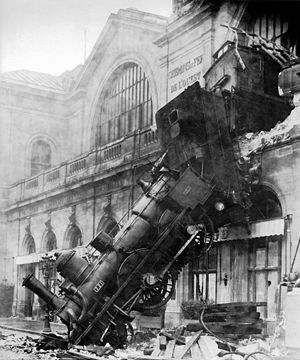
The film also clearly has an educational mission, providing an overview of some aspects of early cinema, with entertaining re-enactments of some of Méliès’ films, extracts from his A Trip to the Moon (1902), and additional footage of classic early Lumière brothers films such as Train Pulling into a Station (1895) and Workers Leaving the Lumière Factory (1895), some early Thomas Edison footage and other classics of American early silent cinema. There are background references to other early European cinema with a poster for Judex, for example, displayed in the foyer of a cinema. There are also allusions to famous photographs, such as a dream sequence of a famous train crash in 1895 at the Gare Montparnasse with the final shot referencing the photograph.

The happy ending does little to attenuate the overwhelming sense of melancholy produced by the film, which comes across in general as a kind of fannish film buffs’ wish fulfilment fantasy. An improbable world where orphans find a new family, where artists are given the recognition and adulation they deserve, where lonely marginalised people (the station master and two people not in the first flower of attractive youth) find romance. But the rediscovery of Méliès during his lifetime is not fantasy and he was indeed recognised for his achievements with a gala being held in his honour in 1929 and further recognition from then on until his death in 1938, which unfortunately for him, did not translate into financial recognition.

For all its accuracy regarding some of the history of early cinema and of Méliès’ career and rediscovery, Hugo offers what appears to have become the contemporary form of the ‘fairytale’. This contemporary reading of the notion of what constitutes a ‘fairytale’ is far removed from older renditions and can also be found in the current series of Doctor Who and in Tim Burton’s films. It is a model which is thoroughly self conscious about its fairy tale status, often dripping with saccharine sentimentality (there is plenty of this in Hugo), the kitsch and the twee with trappings of gothic-lite horror.

As with many graphic novels and films based on graphic novels or with a large CGI component, I find it difficult to make the connection to the world of the everyday. This kind of modern ‘fairytale’ seems designed to offer an ‘escape’ which ultimately results in a kind of melancholy and despair. Nothing can be done about the real world, so the only solution is escape into a delusional world of imagined happiness and bliss – even if that world often has a sinister surreal touch to it. This, incidentally, is why I find the ending of Terry Gilliam’s film Brazil (1985) to be one of the most hauntingly horrifying endings of any film I have seen.

The kind of speculative fiction which do I find it easier to connect with, takes one back into the ‘real’ world, offering a way of reflecting on political and social situations through mechanisms of metaphorical and imaginative form which create intellectual distance, thus allowing particular social and philosophical issues to be viewed from different and productive perspectives. To refer to other contemporary science fiction fantasy: the TV series Supernatural in a number of episodes, directly addresses the question of the relation between speculative fiction and the everyday (but more of that in a separate post). I might also mention Guillermo del Toro’s Pan’s Labyrinth (2006) as another example of an engaged and dark modern ‘fairytale’ which does not indulge in sentimentality and deals with some difficult social and political issues. Perhaps it is whether or not the text provides effective mechanisms for reflecting on social, political and existential matters which is the determining factor for me in my appreciation of the speculative fiction genre. Hugo, to my mind, is pretty thin on the ground in this context.

An additional note here on the CGI. I find that CGI photorealism, paradoxically perhaps, creates a distancing effect never quite allowing me to suspend disbelief. Having said this, however, Martin Scorsese offers some visual wonders in Hugo with some fabulous tracking shots – making marvellous use of the 3D medium. The recreated station in Hugo is an amalgam of meticulously built sets, CGI and post-production wizardry. The clockwork mechanisms on display and the Gothic statues in the courtyard of Georges Méliès’ apartment block are very striking. This unreality is something that also struck me in another film I recently viewed – Joe Maddison’s War (2010) – where the CGI rendered warplanes (and incidentally also another implausible fairytale for adults plot) simply put proceedings into an alternate reality far removed from the real historical events which were World War II.

If I have been critical of Hugo, it is, for all that, something out of the ordinary, visually splendid, and an interesting introduction to the history of film. As a children’s film it might provide more engaging material for both children and their long suffering parents than other ghastly screen fodder on offer – such as last year’s Mr Popper and his Penguins or the latest round of the Alvin and the Chipmunks series to mention only two of the more extreme examples.

Julie and Julia: 365 Days, 524 Recipes, 1 Tiny Apartment KitchenJulie and Julia: 365 Days, 524 Recipes, 1 Tiny Apartment Kitchen by Julie Powell
My rating: *

Julie Powell, Julie and Julia: 365 Days, 524 Recipes, 1 Tiny Apartment Kitchen, Little, Brown and Company, 2005.

I read this book (adapted for film as Julie and Julia) to get some ideas of how to turn a blog on housesitting into a book. Alas, no clues were forthcoming on this front and I found the narrator’s world of overwrought hysterical chaos rather hard to take. It was all terribly domestic as well which I found dreadfully dreary. I think I probably just have to face the fact that I am an unrepentant crime fiction reader and chick lit and variations thereof leave me completely cold.

The post September 11 work in a government organisation trying to sort out the mess is interesting – but again the narrator’s constant state of manic chaos is very wearing – even if the author clearly intends it to be read as amusing.

Cult TV: The Essential Critical GuideCult TV: The Essential Critical Guide by Jon E. Lewis
My rating: ****

Jon E. Lewis, Cult TV: The Essential Critical Guide, Pavilion Books, 1994.

I noticed a few months ago that Google appears to have acquired Goodreads, a social networking and book cataloguing site to which I subscribe. At least that is my explanation for why Goodreads reviews are now listed on the relevant book pages on Google books. Given this higher degree of internet exposure, I decided that my reviews needed tidying up and updating. Most of my Goodreads reviews are already included on this blog, but a few of the more lightweight reviews (not books!) are not. Time to remedy that absence…

Jon E. Lewis’ book on Cult TV is a really useful and nicely put together reference book for TV fans. It is composed of encyclopedia style entries accompanied by black and white photos on a whole host of cult TV series from the birth of television in the 1950s to the time of publication in 1994. It covers a range of genres: science fiction, crime, westerns, children’s programmes, melodrama, adventure and comedy.

I have spent many a happy evening browsing the entries, discovering new series and gathering information on ones already seen. This book was written in the days when fandom really was a specialised subculture before it was quasi mainstreamed by the internet and as such displays the friendly approach that goes along with addressing a relatively small group.

The Artist's Way: A Spiritual Path to Higher CreativityThe Artist’s Way: A Spiritual Path to Higher Creativity by Julia Cameron
My rating: **

Julia Cameron, The Artist’s Way: A Spiritual Path to Higher Creativity, Jeremy P. Tarcher/Putnam; 2nd Edition, 2002.

This book is an international best seller and often referred to in discussions on writers’ process, with many fiction writers claiming it has changed their whole approach to writing and other creative writing teachers and writers referring to it as a notable text in the field.

I bought this book to see if it could offer any tips on writer’s block, but it is a fairly standard New Age self help manual. I am not opposed to New Age approaches but having read so much of this kind of material in the past, new offerings tend to blend into sameness when I read them these days. Some of the suggestions in the book are useful from a technical point of view, but personally I didn’t find them very inspiring. Its firm location in North American culture probably didn’t help me to identify with much in the book either.

By far the best and most practical book I have read on writer’s block is Robert Boice’s well researched Professors as Writers. If his advice is aimed at an academic market, it doesn’t just work for academic writers, it provides helpful tips for writers of all genres.

Cinéma et philosophieCinéma et philosophie by Juliette Cerf

Juliette Cerf, Cinéma et philosophie, Cahiers du cinéma, 2009

This is an interesting short book about the treatment of philosophy in film. It refers notably to Bergson, Deleuze and Godard, Bresson. It includes a photograph of Foucault as a judge in Moi Pierre Riviere as well as many other interesting photos. The author discusses the appearance of real life philosophers in film and films as philosophy – from the perspective of French philosophy (as opposed to the more common perspective of analytic philosophy when it comes to film). It is an interesting read on this front.

The book is not suitable as a textbook for undergraduate students or as an introduction to philosophy using film.

Posted on my site michel-foucault.com

Describing notions of ‘the general form of the Greek conception of language’ in the context of Socrates’ discussions of truth and philosophy, Foucault notes:

‘words and phrases in their very reality have an original relationship with truth …. Language which is without embellishment, apparatus, construction or reconstruction, language in the naked state, is the language closest to truth and the language in which truth is expressed. And I think this is one of the most fundamental features of philosophical language … as opposed to rhetorical [discourse]. Rhetorical language, is a language chosen, fashioned, and constructed in such a way as to produce its effect on the other person. The mode of being of philosophical language is to be etumos, that is to say, so bare and simple, so in keeping with the very movement of thought that, just as it is without embellishment, it will be appropriate to what it refers to.

Michel Foucault, (2010) [2008]. The Government of Self and Others. Lectures at the Collège de France, 1982- 1983. Tr. Graham Burchell. Houndmills and New York: Palgrave Macmillan, pp. 374-5

Random thoughts in response
Foucault notes Socrates’ position that plain everyday speech which directly reflects one’s thoughts and that speaking from the heart or faith are manifestations of ‘true philosophy’. Thus plain language is closer to the truth of things than clever rhetoric: the more artifice that language involves, the more removed one is from the original purity of truth. One can see this long philosophical tradition emerging in analytic philosophy – which struggles to create a pure language to the point of attempting to distil it into mathematical formulae.

Foucault’s book The Order of Things is one long refutation of this philosophical position in relation to language. Foucault radically challenges the notion that language can be ever be a transparent tool for representing things. Language has its own materiality and solidity and its own patterns of order right from its original inception. If there appears to be a connection between words and things it is not one of a true and transparent representation but one of an analogous structure of order. Words can only resemble the order of things through a process of analogy. Neither is thought a pure entity which can be expressed, translated and mirrored by words. Thought cannot be divided from language and the other ways humans represent the world. We are always faced with degrees of fiction: human culture, language and thought are fabrications from the very outset. Culture, history and civilisation can never be stripped away to reveal the pure, naked and authentic truth. Instead it is these very things that help us access the truth about ourselves and our environment. They are the tools that we need to work with and constantly engage with for good or for ill.

To put all this another way: it is a question of the familiar idea that language is a transparent window onto ‘reality’ and that language can truly represent things. This belief has led to the idea that if you make language ‘pure’, then it will give you a clear window onto reality. A language that is full of artifice obscures what is real and fogs up the window. But Foucault argues that language – or discourse – is actually an object amongst other objects and should be treated accordingly. Hence a pure language is not going to get us closer to the truth. We can’t remove ourselves from language and culture – instead of removing ourselves a far more productive approach is to actively engage with them and use them to help us to determine how we can we can live in the present in relation to ourselves and others.

There is more I should add to this discussion. In Foucault’s description rhetorical language is characterised by Greek philosophers as an exercise of power (it is ‘constructed in such a way as to produce its effect on the other person’), whereas the language of ‘true philosophy’ that Socrates is advocating is not a deliberate exercise of power. It is not about manipulating people, it is about revealing the truth and allowing others to decide how to respond to what emerges.

Foucault has, of course, elsewhere in his work, extensively criticised the Platonic forumulation that power and knowledge (truth) are mutually exclusive. In short, the rest of Foucault’s work takes issue with some aspects at least of the way Plato and Socrates construct the parrhesiastic enterprise.

Reposted due to extensive additions and alterations. With thanks to Steve Shann for his comments on the original post.

Links via Stuart Elden’s blog

Geoffrey Galt Harpham notes the following (citation via JJ Cohen at In the Middle)

[Research is] an immense undertaking in which countless people performing the most tedious small tasks are able, collectively, to liberate the modern world from the grip of doctrine, authority, and myth. The value of each contribution can, he says, be measured only in the aggregate, and in many cases only much later: many scholarly or scientific projects are like abandoned mines, awaiting rediscovery by future generations. … Redundancy is the price we pay for other, less measurable but very real benefits. But we should be concerned about the mind-set that sees the past as inert, the humanities as old knowledge, and scholarship as the problem. [1]

I find this a wonderfully inspiring and optimistic statement. Often one worries as a writer or researcher that one has nothing to contribute to an already massively overcrowded field and that neither can one ever hope to measure up to the standards set by major artists and scholars who stand out through their innovation and immense productivity. Further to this, are the problems of navigating the enormous bureaucratic and ideological pressures exercised on those teaching and conducting research in universities at present.

Harpham argues that every little bit counts and is worth the effort: an approach that one also finds in Foucault’s work. It is the optimistic view that every human action, every human investigation makes a difference, no matter how tiny. Certainly, at present, concerted mass efforts are required to resist the logic currently in evidence in every social sector: a logic which seeks to organise systems into immovable and well-oiled mechanisms which work well for a few, but less well for a great majority. A logic which also seeks to convince people that their contributions are of no value, reducing them to inaction and despair – a condition which makes them easily tractable – ‘passive and docile bodies’ indeed!

[1] Geoffrey Galt Harpham “Why We Need the 16,772nd Book on ShakespeareQui Parle: Critical Humanities and Social Sciences, Volume 20, Number 1, Fall/Winter 2011, pp. 109-116)

Kate Clancy notes the following on The Scientific American blog (link via Jo VanEvery’s blog)

But are peer-reviewed publications, read and cited by only by a select group of those peers, the best way to assess influence and importance? They are certainly no longer the only way. My 2006 paper on iron-deficiency anemia and menstruation has been cited by six other papers; my 2011 blog post on this paper has been viewed tens of thousands of times and received almost sixty comments between its two postings. Some anthropology blogs have been responsible for starting entire new branches of the discipline, others show an applied side of anthropology that helps us see the impact of this field in our everyday lives; some ground their writing in a historical and evolutionary approach or move us with their perspective on war and poverty, where still others are not only influential, but regularly get more hits than the website for our main professional association. Some use their blog as a service to the discipline, and a newcomer is dispelling myths about milk (full disclosure: both of those blogs are by collaborators, kickass collaborators in fact). This is by no means an exhaustive list.

This is another confirmation of earlier observations I and others have made about the relative impact of academic blogging and publication in peer reviewed journals. Kate Clancy also remarks

There are two problems with the current criteria for tenure: they don’t reflect modern, interdisciplinary scholarship, and they don’t include metrics to evaluate influence and perspective beyond peer-reviewed publications.

One might add that this applies to criteria for promotion as well as tenure. There is no doubt that the global university as an institution is ill-equipped at present to deal with innovative practices engaged in by the academics in its ranks. This is perhaps one of the effects of the corporatisation of the university over the last twenty years. Academics have been recast as employees of an institution, rather than the university being an administrative arrangement to support the work of academics as they seek to introduce innovation into various fields – including how their own work is dessiminated within the social body.