Refracted Input

Clare O’Farrell’s blog on books, TV, films, Michel Foucault, universities etc. etc.

Posted on my site michel-foucault.com

I shall sum up […] the critical operations which I have undertaken [To question] these three themes of the origin, the subject and the implicit meaning, is to undertake – a difficult task, very strong resistance indeed proves it – to liberate the discursive field from the historico-transcendental structure which the philosophy of the 19th century has imposed on it […]

There where one used to tell the history of tradition and of invention, of the old and the new, of the dead and the living, of the closed and the open, of the static and the dynamic, I have undertaken to tell the history of perpetual difference; more precisely to recount the history of ideas as the sum of the specified and descriptive forms of non-identity.

Michel Foucault, (1996) [1968]. “History, discourse and discontinuity” S. Lotringer, ed., Foucault live (interviews, 1961-1984) (New York: Semiotext(e), 1996), Translated by Anthony Nazarro, pp. 41-2. Translation modified.

Random thoughts in response
Foucault defines the event as something that has a beginning and an end. Every human experience, activity, idea and cultural form can be analysed as an event or as a series of events. Foucault uses this concept as a way of arguing against metaphysical essences in history. It is important to emphasise that his notion of the ‘event’ shares little in common with the event as it has been defined by other forms of philosophy which define it as the rare and earth shattering eruption of transcendence (or the eternal) into history.

If each event has a discrete beginning and end, it does not exist on its own, it can only exist in relation to other events and to other levels of events. An event when it begins, is already part of a history and a social and cultural structure. It both perpetuates and marks a break or difference – no matter how small – from those structures. It is both the Same and the Other.

Foucault also applies notions of the event, of difference, to his discussion of the formation of the self. The self is likewise an ‘event’. We are born into a language, culture and historical situation and we are trained by, and train ourselves, with the tools produced by our history and culture. At the same time, however, we have the capacity to modify how we belong, to make a unique contribution.

People are continually trying to tie things down and render them the Same so as to maintain social and other forms of order, but the Other, that which is different, keeps on dissolving these orders. One could argue, using worn out and questionable philosophical terms, that in Foucault’s work, this Other is ‘immanent’ rather than ‘transcendent’. Hence the Other is something that is constantly present and in dialogue with what is going on here and now and in ordinary lives. Continual difference pervades our existence, opening up the possibility for transgression at every moment, not just exceptionally. Of course, whether or not people take up the opportunities offered is another matter.

Thus one can oppose the terms ‘difference’ and ‘transcendence’. There is a vast tangle of moral judgment and elitism attached to the notion of ‘transcendence’, given only some people and some situations have access to it or are effected by it. Transcendence also reductively subsumes everything into itself and removes it from history. The term difference never operates this reduction and has far fewer grand pretensions. It doesn’t merely emerge in chosen moments but remains stubbornly historical and of this world. Transcendence has reductive and elitist overtones and is rare, whereas difference is multiple, common and accessible to everybody. Transcendence tends towards a gnostic rejection of the world, a removal to an eternal outside place (or non-place), difference tends towards an active engagement in history and the recognition of injustice.

For thinkers such as Arendt, Agamben and Badiou if the event is indeed singular, only certain events count and those events are rare. These events take on the status of crisis, revolution, exception, the extra-ordinary, the definitive break, wholesale political transformation, the departure from biological or animal necessity. Other occurences simply exist in the shadow of these rare or formative events.

Hannah Arendt, while eliminating the notion of causality and championing the cause of history, posits the idea of the division of action into two forms – one that is characterised as everyday and concerned with the mere maintenance of biological life and the social and cultural status quo and the other as ‘extraordinary action’, which has political and innovative effects. The second form of action is clearly more highly valued than the first.

The risks of elitism in proposing such a divide are high – as has of course been pointed out in various ways by Arendt’s critics. Some people become capable of producing worthy social and historical action, whereas others are condemned to spend their lives as anonymous drones. And disappointingly, especially given Arendt is a woman, those concerned with the biological continuation of the species rather than grand politics, often happen to be women.

Foucault, on the other hand, argues that all actions, thoughts, experiences and physical happenings are historical events which at one and the same time both maintain the status quo and depart from it to varying degrees. Every event by sheer virtue of the fact that it appears in time (history) both belongs to what has gone before and marks a departure from it. This departure or difference can be either virtually non-existent or large – but there is no division in what qualifies as an event and what doesn’t. There are no fundamental ontological differences between types of events, just differences in levels and strategic placement and degrees to which actions or events are transgressive (or not). And further, one has to think very carefully about how one valorises the transgressive.

So rather than a metaphysical reading of the event – where the transcendent comes down and erupts into history or negates history altogether in the maintenance of transhistorical essences, Foucault offers a historical reading where difference permeates everyday existence from moment to moment. This is not to say that the notion of difference is at a fundamental ontological level any more explicable than transcendence or less intriguing, but it is certainly far less pretentious in its ambit and a far more operable and empirically observable notion in terms of the analysis of micro-events and practices.

With thanks to Eduardo Duarte for starting the discussion which prompted these ideas.

Sculpting in TimeSculpting in Time by Andrei Tarkovsky

Andrey Tarkovsky (1989) Sculpting in Time. Reflections on the Cinema. Translated from the Russian by Kitty Hunter-Blair, University of Texas Press.
My rating: *****

Publisher’s page. Includes table of contents and extract.

I want to underline my own belief that art must carry man’s craving for the ideal, must be an expression of his reaching out towards it; that art must give man hope and faith. And the more hopeless the world in the artist’s vision, the more clearly perhaps must we see the ideal that stands in opposition to it – otherwise life becomes impossible!

I have been reading Tarkovsky’s truly wonderful book in which he reflects on and explains the thinking that went into his films. If some of the language in the citation above, with its mention of the ideal, hope and faith appears old-fashioned to hardened veterans of the new millennium, it would appear nonetheless, as Tarkovsky argues, that life is still impossible without these things. Having recently viewed a TV series, Spirited, which after the long and careful establishing of two strong and independent characters with a positive control over their own existences, suddenly in the last three episodes, opts to turn them into the pathetic victims of a cruel and heartless universe, his remarks seem very apposite.

Faced in this case with what essentially appears to be a radical loss of faith and hope by the writers in their own creation, the consumer, who feels betrayed by this loss, is left wondering which way to turn. Perhaps this is the experience of many fan fiction writers. (Just to be specific, this is not an art form that I personally practise). And indeed not just fan fiction writers, but a whole range of other creative practitioners. They are forced into creating their own story to make up for the failure of other texts in providing the ideal they were hoping for. Thus in some instances, they might actively engage, as Tarkovsky would have it, in opposing the hopelessness of particular artistic visions.

One could take this further and argue that in Lyotard’s postmodern world, everybody is looking for the perfect story and when they don’t find one ready-made, they are forced to create their own. This applies as much to the most esoteric flight of theory as to the trashiest piece of fan fiction. It applies to a range of other practices as well – including the political, and right down to the way people tell themselves the story of their own lives. This desire to create one’s own story is, of course, by no means simply limited to the so-called postmodern age or culture. As many have argued, the desire to tell and to consume story is something deeply embedded in human experience. Story is not simply about diversion, bread and circuses, the mindless ‘entertainment’ much touted by Hollywood and its ilk. Story is about imagining better (or worse) worlds, of reflecting on our everyday and the possibilities of human experience, and experimenting with different ways of thinking those possibilities.

Les philosophes et l'amour: aimer de Socrate à Simone de BeauvoirLes philosophes et l’amour: aimer de Socrate à Simone de Beauvoir by Aude Lancelin

My rating: ***

Aude Lancelin et Marie Lemonnier (2008) Les philosophes et l’amour: Aimer de Socrate à Simone de Beauvoir. Paris: Plon

I was prompted to read this book by Alain Badiou’s reference to it in his essay In Praise of Love. Written by two female journalists working for the prominent French intellectual and cultural weekly Le Nouvel Observateur, this book is a lively, well-written and often subtly ironic account aimed at an educated general public.

The authors point out that love and philosophy have never made happy bed fellows with philosophers engaging in only limited discussion on the notion of love. Further, what discussion does exist, is very one-sided as most philosophers historically have been male.

The philosophers the two authors examine, with numerous additional references to both historical and contemporary works of fiction and other philosophers, include Socrates, Lucretius, Epicurius, Montaigne,Jean-Jacques Rousseau, Kant. Schopenhauer, Kierkegaard, Nietzsche, Heidegger and Arendt, Sartre and de Beauvoir.

For all the generosity of the authors in trying to render justice to these thinkers, they cannot help but highlight the outrageous hypocrisy and frequently toxic practices and ideas of the chosen philosophers. The two female philosophers, Arendt and De Beavoir, are unfortunately on a par with the men. If one is looking for positive, insightful or even helpful writing on love and male female relations this book demonstrates that one should under no circumstances turn to mainstream Western philosophy (for all Alain de Botton’s attempts to reinstate Schopenhauer in his book The Consolations of Philosophy).

If however, one is interested in some of the less pleasant byways of the human psyche or insights into the historical ideas that have aided and abetted ongoing hostilities between the sexes and the denigration of women, then a reading of mainstream Western philosophy is an instructive if somewhat gloomy experience.

In Praise Of LoveIn Praise Of Love by Alain Badiou

My rating: ***

Badiou, Alain with Truong, Nicolas (2012) In Praise Of Love. Trans. Peter Bush, London: Serpent’s Tail

I approached this short essay interview about the notion of love (as it is enacted between lovers) with caution. I was not expecting a 75 year old male philosopher to have much to say that would resonate from a female point of view. There was however slightly more on the table than I expected and some of the discussion provided potential food for thought which crossed gender lines.

I was particularly interested by Badiou’s comments criticising the portrayal of love as something that exists in a moment outside of time. This is a view that pervades romantic literature. It is a love that cannot be enacted in the real world or survive through time. It is also reductive, fusing the difference of two into one. A philosopher like Levinas (whose religious focus Badiou rejects but adapts for more secular purposes) would argue, of course, that love presumes difference and can only exist where difference exists, it is never reduction to the Same. Badiou remarks:

‘I think many people still cling to a romantic conception of love that in a way absorbs love in the encounter. Love is simultaneously ignited, consummated and consumed in the meeting in a magical moment outside the world as it really is. something happens that is in the nature of a miracle, an existential intensity, an encounter leading to meltdown.’ (p. 23)

He cites Tristan and Isolde as an example, continuing that we need to challenge this romantic conception which although it might be beautiful in art fails to make the transition to real life. He notes:  ‘Real love is one that triumphs lastingly, sometimes painfully, over the hurdles erected by time, space and the world’. (p. 24) The duration of love is seldom dealt with in fiction (p. 50) which usually focuses on the ‘ecstasy of [..] beginnings’ (love at first sight, the ‘encounter’) and ends with ‘they got married and lived happily ever after’. He mentions Samuel Beckett as a somewhat unexpected exception. (I might add paranthetically that Flaubert’s Madame Bovary is of course a demonstration of the pitfalls of trying to apply the myths of romantic fiction to everyday existence.)

One can look at this problem in relation to a variety of TV series and films. The stock standard romantic comedy of course usually falls within the expected boundaries of the magical encounter and then the happy end. Another ploy is to kill off one or both partners in order to preserve the purity of their love and happiness from the ravages of time. Many American TV series try the strategy of indefinitely postponing what the writers seem to regard as the inevitable suburban and domestic doom of all relationships, by failing to get the couples together in an infinitely prolonged process which fans commonly label as UST or unresolved sexual tension. Henry Jenkins, the noted scholar of fandom, complains about this common fan frustration in a post on his blog titled ‘A Rant About Television’s Difficulty in Representing Committed Relationships’. He observes:

I often suspect that Hollywood’s inability to depict relationships that grow over time has everything to do with the divorce rate in the entertainment capital, very little to do with the constraints of the medium (given how well television depicts the unfolding of interpersonal relationships over time) and even less to do with the desire of fans. (One of the things to pay attention to is how many of the “commitment” episodes for television series are written by a small handful of writers who have consistently ruined every couple they touched.)

He also adds interestingly that ‘contemporary writers seem incapable of writing such relationships — could it be because they are twenty-somethings still recovering from their first major breakup?’ The convenient (American) production myth has it that if you get two characters together in a series, viewers will lose interest. Perhaps this is because the writers can’t seem to imagine a relationship other than a white picket fence with both partners doomed to the drudgery of ball and chain domesticity. (Perhaps these writers could read up a bit on alternative models for relationships such as the ‘commuter marriage’, popular in academic circles). A couple of series which readily spring to mind in terms of being unable to come to a sensible resolution on this front are Remington Steele and La Femme Nikita (the 1990s series).  There are many others. Jenkins cites Castle as perhaps an exception, but I beg to differ. Like Bones, I find that if the writing in this series is able to sustain fairly basic (and not terribly adventurous) characterisation, it is less successful in demonstrating how those characters are modified by their relationships with each other.

Attempts to show long(ish) committed relationships in romantic comedies like Brett Ratner’s The Family Man (2000) can also be dreary, unconvincing and unbearably saccharine. One can only wonder what demographic this particular film was addressing.  The story takes place from the point of view of a rich executive male (Nicholas Cage) with a Ferrari and a string of one night stands, who slips into a parallel world of ghastly suburban domesticity of seemingly volontary semi-poverty with a one time girlfriend. The film – or writers – seem irretrievably torn between (what they regard as) the moral example which is life in the suburbs versus the guilty but exhilarating freedom of a high-flying Christmas-neglecting single life.

Returning to Badiou’s terminology, there is good material out there which shows love between couples (of any orientation) as duration rather than the momentary eruption of the eternal into the real, but one has to search for those rare examples amidst the mountains of dross which foreground the love/romance event with all its artificial boundaries and dubious links to the transcendent eternal.

This is another piece from my defunct film website. Written way back in 1998, before science fiction fandom became ‘mainstream’

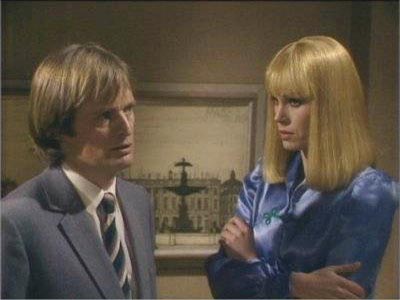
I first came across Sapphire and Steel, an obscure British science fiction series made in the early 1980s, while I was browsing through a mail order catalogue in the late 90s. I read the description: ‘a strange and fascinating show – definitely something different’. Always on the lookout for the unusual, I ordered volume one expecting no more than the usual B grade offering that is unfortunately usually the rule when it comes to television science fiction. I was more than pleasantly surprised when I discovered something that actually did match the catalogue description. By the end of Adventure 1, I was hooked and submitting my credit card to a severe workout, I ordered the remaining 5 Adventures on tape. At the same time as I was watching the series I was also reading the works of Antonin Artaud. The combination was quite extraordinary – the television series echoing a number of Artaud’s insights into the radical disjunction between words and things.

The piece below probably won’t make a lot of sense unless you have seen the series. An overview and information can be found on the Wikipedia page for the series. You might also like to have a look at an earlier post on Sapphire and Steel on this blog.

Introduction

One of the most striking features of Sapphire and Steel is the fact that it offers so few explanations and so few obvious answers. Not only do the backgrounds of the characters and events remain mysterious, but the most ordinary objects take on completely unexpected meanings. A feather pillow becomes a dangerous vengeful creature, a nursery rhyme the physical manifestation of an evil force, a travel chess set a terrifying weapon and gateway to time and other dimensions. Nothing can be taken for granted in this series.

This indeterminacy of meaning and explanation encourages viewers to actively imagine and speculate, to create their own very personal interpretations, to face particular types of limit experiences and the possibility of other worlds using the structure of their own psyches and imaginations. The whole series is an invitation to think beyond it, to engage in difficult confrontations and experiments in thought and imagination: it is an open challenge to question accepted visions of social and physical reality without this ever being a stated or obvious intention of the series. Thus, even if the series is a relatively short one, it offers far more fodder for creative discussion and invention than do a number of other longer running productions with more elaborately developed and codified world views and with far more visible signposts as to their intentions.

This article will take up the challenge and provide speculative answers to questions raised by Sapphire and Steel. These answers are by no means intended to dispel the original mystery and indeterminacy: their purpose is rather to open further opportunities for debate, speculation and imagination… And what better place to start than with the most obvious question?

Who are Sapphire and Steel?

Ostensibly, Sapphire and Steel are two operatives who are sent to earth to prevent or repair ruptures in the strictly ordered fabric of time, to maintain the integrity of past, present and future. These disruptions to time are initially assessed by ‘investigators’ who are never seen, who then brief and send in ‘operatives’ such as Sapphire and Steel. ‘Specialists’ are sent to the scene at a later stage to undertake any specialised tasks that operatives are unable to perform. This rather summary information emerges in a somewhat fragmentary and incidental manner at various points throughout the series in conversations between the two main characters, with humans and with the two specialists Lead and Silver. This is what Sapphire and Steel do but what sort of beings are they and where do they come from?

Are Sapphire and Steel alien or human?

This question is worth asking for a number of reasons, especially in view of a regrettable tendency in many American science fiction series in particular, to make most of the principal ‘alien’ characters semi-human at least in some way. In the original Star Trek, the alien Spock is only ‘half’ Vulcan, the ‘other half’ is human. The crew of the Enterprise in the next generation of Star Trek features a half human betazoid, a Klingon brought up by human parents and an android engaged in a life long quest to become human. And in conversations between the alien Q and Captain Picard we see the standard rhetoric that for all their faults and weaknesses, humans have ‘special qualities’ unique in the universe. In the other two offshoot series of Star Trek, Deep Space 9 and Voyager, the resident aliens are even more tedious and predictable than the humans. It might be argued that Babylon 5 is slightly better on this score – but the writer Joe Michael Straczynski still cannot resist the temptation of mixing human with one of the more ‘noble’ alien races, the Minbari. The Vorlons have also demonstrated suspicious fraternising tendencies – of a kind at least – in their use of figures such as Jack the Ripper to do their dirty work for them. Neither can Straczynski resist the ‘unique quality of humans’ school of rhetoric. Even in that post gulf war expression of military paranoia Space Above and Beyond, it transpires that the evil and hideous aliens had somewhere back in depths of time originated from the planet earth. British science fiction tends to perform a lot better on this front, but not even the Paul McGann version of Doctor Who, it seems, can survive a trans Atlantic regeneration intact. In a truly horrifying gesture, undermining a fine tradition of long standing – the completely alien doctor suddenly acquires a human parent, thereby ‘explaining’ his long term interest in earth. Is it really necessary to be part of a species or culture to show some interest in it? Why is there such a determined and rigid obsession with rendering the entire universe human in American science fiction? This is indeed a fascinating problem and certainly one worth exploring at more length. As some writers have suggested all of this is perhaps a thinly disguised reflection of the USA’s current imperialist stance with regards to cultures which are not American.

In such a human centred universe, Sapphire and Steel are a welcome arrival. They are clearly alien ‘in the sense of being extraterrestrial’ as Steel confirms in as many words in Adventure 5. Attempts to appropriate anything like a ‘human past’ for Sapphire and Steel have been firmly but politely rejected by the writer of the series P.J. Hammond in an interview with Rob Stanley.

How do Sapphire and Steel differ from humans?

As P.J. Hammond remarks, if Sapphire and Steel are more than ‘mere mortals’ they are still to some extent ‘mortal shaped’. They both speak English (that well known universal tongue!) and appear to have a human form, but for all this, the nature of their relationship to their bodies is uncertain. The opening animation, which shows glittering spheres representing a number of different ‘elements’, might suggest that their human shapes are something they adopt for the sake of convenience. Yet in Adventure 4, Sapphire, addressing a creature which changes its face at will, states that she and Steel have only ‘one face’. Their bodies can also be damaged as various incidents with absolute zero temperatures, barbed wire, knives, imaginary swans and attempts at strangulation indicate, but at the same time they appear to have remarkable powers of regeneration. In Adventure 3, the technician Silver refers in passing to a faculty of ‘instant reduplication’ which might explain these recuperative powers, but even this, it appears, is fallible. It is the failure of this faculty which results in his disappearance into his own past at the hands of the changeling, and he also mentions when threatened by the transient beings, that he would not survive in the Triassic period. One thing is clear, however, the relation Sapphire and Steel and similar beings have to their bodies is quite different to our own.

The fact that they are not human is apparent right from the outset. Almost as soon as they walk in the door in Adventure 1, we see Sapphire’s eyes turn a brilliant shade of blue as she briefly investigates the situation. The two operatives are able to communicate telepathically with each other and have obviously arrived at the house through some means of transport other than the more conventional ones of car and boat, which as the boy explains can be heard coming for miles in that isolated spot. Adventure 2 shows them teleporting and they make more use of this power in subsequent adventures. A marvellous but very brief scene in Adventure 5, a fine example of Shaun O’Riordan’s direction, offers perhaps the closest thing on film to a subjective view of teleportation. The background behind Steel fades to black and we see him in a closeup shot turning to face a new environment. Other series, notably Blake’s 7, Star Trek: The Next Generation and The Tomorrow People have all attempted subjective views of teleportation, but where Sapphire and Steel is radically different is in the fact that the two main characters do not require technology to assist them. Neither does Steel signal in any way his intention to teleport. Like many other scenes in the series it remains mysterious and there are no obvious indications as to how the viewer is meant to interpret it. As a result, this sequence arguably works far better than other more detailed and elaborate efforts to convey what teleportation might actually feel like.

It would also appear that the two agents have a very long lifespan in our dimension. In Adventure 1, they reveal that they dealt with a problem on the Marie-Celeste and indicate in Adventure 4 that the passage of hundreds of years is of little consequence to them. They have other powers as well: the enviable ability to change clothes and hairstyles in the blink of an eye, for instance. Sapphire parades a number of outfits in front of Rob in Adventure 1 and both she and Steel waste no time changing into their thirties costumes in Adventure 5. In addition, they both possess telekinetic abilities – very handy when it comes to locking and unlocking a variety of doors and turning off record players! Sapphire is able to ‘take time back’ for limited periods, to ascertain the age and nature of objects and to access historical data of both a general and individual kind. Steel can reduce his body temperature to just above absolute zero and he is very strong both psychically and physically and often acts as a kind of anchor for the more volatile Sapphire. Both of them appear to have hypnotic powers of persuasion over humans which they can exercise by a touch or a gaze but they only seldom choose to do so.

But these things aside, what most marks them as alien is the way they respond to situations and the kind of remarks they make about humans. They clearly regard humans as very different from themselves and Steel, in particular, frequently expresses a mixture of exasperation and puzzlement over human behaviour and customs. First impressions of both Sapphire and Steel are of a rather chilly and impersonal detachment. Steel is frequently abrupt to the point of downright rudeness and while Sapphire might initially appear more gracious, she is certainly a match for Steel when it comes to coolness. While shaking hands and making polite conversation with Tully, she is in reality communicating a cold scientific analysis of her subject to Steel.

Neither of them react in quite the ways we would expect people to react in similar situations, yet it is not a question of that other well-worn science fiction cliché: the aliens-who-know-no-emotions in the face of a unique, and as such, admirable, human prerogative. It is more a question of a different emotional response – one that does not always match our well trained social expectations. There is, for example, a definite, if very understated, romantic attachment between Sapphire and Steel, but the way this is played out is by no means conventional, leading some viewers to wonder whether their feelings for each other are real or indeed, whether they exist at all. Again, nothing is at it appears to be: the coldly distant demeanour of both characters is continually belied by their actions in taking the most extreme risks to save humans at every possible opportunity. If Tully is sacrificed, it is to save hundreds of human ghosts. Both Sapphire and Steel endanger themselves to help the woman in Adventure 6, Steel explaining to Silver that it is their duty to do so. Indeed, it is perhaps as a direct result of this concern that they are caught in the trap at the end. Both agents, in fact, display strong, if strictly controlled, emotional responses in relation to humans on a number of occasions. For example, when Steel realises that he has almost stabbed a baby and when the creature in Adventure 4 burns two people alive in a photograph, he is clearly upset. There are numerous other examples. But all these observations do no more than raise further interesting questions, further fodder for speculation. They merely begin to scratch the surface of the hundreds of possible questions that one might ask…

Links to other Sapphire and Steel pages

Revisiting Sapphire and Steel
Sapphire and Steel. Sci Fi Freak site
Page on TV Tropes
Stephen O’Brien SFX magazine
Page on British Horror Television
An Extract From Mark Fisher’s Ghosts Of My Life. A reflection on Sapphire and Steel

Warning spoilers

My rating: ****
imdb link

While on things vaguely religious, I thought I would post up another item from my now defunct film website. I originally wrote this review in 2002. I have made some very minor updates.

Plot
A New York doctoral student in philosophy, Kathleen (Lili Taylor), gets bitten by a female vampire in evening clothes and becomes one herself. Drifting aimlessly and neglecting her thesis, Kathleen stumbles across an ancient vampire called Peina (Christopher Walken) who promptly sucks all her blood and gives her a lecture on philosophy and literature which inspires her to finish her thesis. A post-doctoral party becomes a vampire feeding frenzy and Kathleen, having already infected the rest of her philosophy department, ends up in hospital. There she repents of her addiction to evil, dies and is saved. The film’s dialogue consists mainly of heavy duty quotations from, and discussions of, pre-1960s philosophy, mostly of the existentialist and Jansenist variety.

Review
This is not a movie for the faint hearted. But then Abel Ferrara‘s films never are. This bizarre and intense film operates at a number of levels: first of all, as a suitably blood-festooned vampire flick (although the word vampire is never mentioned). Secondly, it operates as a philosophical and religious reflection on human evil and redemption and finally as an amusing take on certain aspects of university life, probably best appreciated by those directly involved in that venerable institution.

To comment first of all on its vampire credentials. It helps if one has more than a passing familiarity with the vampire genre in order to stomach the gore. The action is filmed in black and white which helps distance the viewer from the more graphic elements. Indeed in colour, the effect would probably have been unintentionally comic, evoking the lurid excesses of Hammer horror in its hey day. Even so, a vampire feeding frenzy at Kathleen’s post Ph.D party looks amusingly like some avant-garde actors’ workshop. Having said this, if there were such a thing as vampires, this would probably have to be the most realistic depiction of the sheer mechanics of their practices in all their repulsiveness. No romantic sparkling vampires of the Twilight variety here! But in the end it is probably the documentary images of the piles of bodies in concentration camps at the end of World War II which form the most disturbing visual material of the film. As for sound, the most disgusting scene must surely be the evil vampire Peina sucking Kathleen’s blood.

But the core of this film is its philosophical and religious reflection on evil. Clearly writer Nicholas St. John has been reading some heavy duty philosophy of the most gloomy existentialist kind: Nietzsche, Kierkegaard, Heidegger, Sartre, Beckett, Baudelaire and theologians such as Calvin and J.C. Sproul are referred to and quoted at some length by the characters. It seems he wrote this film and Abel Ferrara’s The Funeral (1996) after his son’s death. No-one has a mundane or even a remotely cheerful conversation in this film and certainly no-one refers to any philosophy produced more recently than 1960. No Foucauldian, structuralist, or postmodern vampires here! The tone is reminiscent of such Catholic pre- and immediately post-war novelists as Graham Greene, Shusaka Endo, Georges Bernanos and François Mauriac – all heavily influenced by a bleak angst ridden Jansenist outlook. One is also reminded of the French film maker Robert Bresson’s approach –  another atheist/Catholic film maker who was concerned with showing how evil people could be and the grace of God that could save them in extremity.

The only people in the film able to resist the lure of the vampire are a priest and a young man handing out religious pamphlets in front of the building where the post-doctoral gore fest is about to occur. Kathleen, after having her vampire advances rebuffed by the young man, goes inside and starts screaming hysterically ‘I will not submit!’, an obvious reference to Lucifer’s ‘non serviam’. The whole premise of the film seems to be that if one does not recognise and face the evil within oneself and the rest of mankind and accept the saving grace of the Christian God, then one is controlled by evil, becomes addicted to it and is compelled to pass it on to others.

The nausea of existence à la Sartre is also much in evidence – quite literally as the newly made vampire Kathleen sits in a café and toys digustedly with her food. Nonetheless, for all its references to the philosophy of another era, this is very much a film of the 1990s with its passing references to AIDS and its view of postmodern social detachment and disconnection.

The philosophical dialogues and pronouncements of the various characters are anything but naturalistic and it helps to have some philosophical background to follow what is being said and the links between the action and the talk are not always clear. This produces a similar, but perhaps less extreme effect, to the one produced in Luis Bunuel’s film The Milky Way where characters from different periods in history conduct sword fights, drink in taverns, sing at school fêtes, all the while discussing the finer points of medieval Catholic doctrine or arcane heretical deviations. But the radical disjunction between words and things or actions is an attractive one and serves to emphasise the non-naturalness of all human words and actions.

Along the way Kathleen meets an evil and corrupt vampire who tells her his name is Peina and who is able to control his hunger and pass as human through a kind of asceticism of evil – a Nietzschean will to power. He has managed to make his evil mundane and almost invisible and he is able to control it for his own purposes which makes it far worse than Kathleen’s. Peina achieves a kind of perverse evil enlightenment and asceticism through the management of his addiction. Kathleen is more classical in her salvation but is far less interesting because we don’t see her involved in anything like the 12 steps to get to that point. All we see is the addiction and then the miraculous salvation. Peina on the other hand has a whole ascetic practice which is much more intriguing – but it is an asceticism in the service of darkness rather than light.

I would suggest that any postgraduate student who is having trouble finishing their thesis would probably benefit from Peina as a supervisor. He roars at Kathleen frighteningly: ‘You are nothing! You know nothing!’ gives her a reading list of French and German philosophers and Beckett then sucks all her blood. Prior to running into this vampire she had been neglecting her thesis. Afterwards she gets on and finishes it. Amusingly, by the end of the film Kathleen has turned most of the philosophy department into vampires. Some academics would no doubt feel quite at home with the whole notion of postgraduate students sucking their blood.

This is not a big budget production and the filming is rough and ready but it is the ideas that carry this work. Watching this flawed film, if not always a pleasant experience, is certainly a challenging and thought provoking one and as such well worth the effort.

Religion for Atheists: A Non-Believer's Guide to the Uses of Religion Religion for Atheists: A Non-Believer’s Guide to the Uses of Religion by Alain de Botton
My rating: 4 of 5 stars

[Secular society] expects that we will spontaneously find our way to the ideas that matter to us and give us weekends off for consumption and recreation. Like science, it privileges discovery. It associates repetition with punitive shortage, presenting us with an incessant stream of new information – and therefore it prompts us to forget everything.

For example, we are enticed to go to the cinema to see a newly released film, which ends up moving us to an exquisite pitch of sensitivity, sorrow and excitement. We leave the theatre vowing to reconsider our entire existence in light of the values shown on screen, and to purge ourselves of our decadence and haste. And yet by the following evening, after a day of meetings and aggravations, our cinematic experience is well on its way to oblivion, just like so much else which once impressed us but which we soon enough came to discard.

Alain de Botton, Religion for atheists. A non believer’s guide to the uses of religion, London: Hamish Hamilton p. 133

Random thoughts in response

De Botton argues that religion is aware of our propensity to forget and provides repetitive structures, activities and calendars to continually remind us of the important things. This is something that secular society does not do, except when it comes to work and economic productivity, leaving us free to source inspiration from wherever we can find it. This means we forget and don’t reinforce self transformative practices. From an entirely different angle, John Medina in a popular science discussion of how the brain and memory works posits as ‘brain rule’ number 5 ‘Repeat to remember’ and ‘brain rule’ number 6 ‘remember to repeat’. In short, repetition is essential to the process of learning. [1]

One could consider media fan practices of viewing long form serial television in the context of these two discussions. Fans will draw lasting lessons and engage in transformative practices of the self by exercising quite particular viewing practices in relation to their chosen subject matter. Although films – particularly films which have sequels – are also subject to fan activity, television series are perhaps more strongly susceptible to a certain kind of work on the self. A television series features a story, characters and a universe that can sometimes span years in real time and is delivered in weekly, sometimes daily instalments. Thus, we have a regular calendar occurrence which keeps the material present in the viewer’s mind. Further to this, a typical fan viewing practice is to view episodes multiple times, and to repetitively rewind and review select short scenes within those episodes. The fan may then go on to further reinforce this input by transforming it into creative and social practices such as discussion with other fans, fan fiction writing or other creative output.

This process allows the fan viewer to assimilate those lessons and insights that they have connected to and garnered from the source text. Thus the fragility of the secular experience of art, drawn attention to by de Botton, is counteracted by certain kinds of fan practices. This indicates, perhaps, that there exists considerable resistance to contemporary incitations to engage in a disposable consumerism that has no term. Further, if one goes down the sometimes dubious brain science route, it might indicate that people continue to be aware of the techniques that need to be practised to foster learning and self transformation. In either case, it is clear that living in an unstable void of an endless featureless stream of temporary rhizomic connections is not an attractive proposition to many people.

[1] John Medina, Brain Rules, 12 principles for surviving and thriving at work, home, and school, Brunswick: Scribe Publications, 2008, pp. 119, 147

A version of this piece was published in The Australian Higher Education Supplement on 4th April 2012 as ‘Credit where it’s due – but who deserves top billing?’ I posted this on my blog last year but have moved it up as I have made quite a few revisions.

We do not characterise a ‘philosophical author’ as we do a ‘poet’, just as in the eighteenth century, one did not construct a novelist as we do today. Still, we can find through the ages certain constants in the rules of author construction.

Michel Foucault, ‘What is an author? In The Foucault Reader. Edited by Paul Rabinow. Harmondsworth: Penguin, 1984, p. 110

Random thoughts in response

In the late 1960s, French theorists Roland Barthes and Michel Foucault famously pronounced the author to be, if not dead, then decidedly fragile. Foucault in his 1969 article ‘What is an author?’ drew attention to the considerable ambiguity surrounding contemporary and historical notions of the author, defining the author as the originator of certain socially agreed upon types of writing.

To explain what he means by the ‘certain constants’ referred to above, Foucault invokes the four criteria Saint Jerome used to determine whether a body of work had the same author, namely (1) consistent quality across works attributed to one author (2) conceptual and theoretical coherence (3) consistent style (4) references only to events which happened before the designated author’s death. (p. 113) While recognising that Saint Jerome’s criteria might appear very simplistic in the context of contemporary literary criticism, Foucault argues they are still descriptive of the basic processes used to attribute authorship.

What I want to do here is offer a few reflections on the idea of the author in the current university context. Authorship is perhaps one of the most highly prized commodities in the academic world. It is used as a measure of reputation and a measure by which individuals are judged worthy of promotion through the ranks of what remains an intricately feudal hierarchy. Being an author who has produced numerous works published by prestigious publishing houses and journals and which are cited and otherwise referred to by many others (‘impact’) is the nirvana of academic achievement. Other functions such as being a good teacher, a good administrator or engaging in community research and consultancy, still come in a remote second in this tacitly agreed upon academic pantheon, in spite of the best efforts of university administrations to valorise these latter roles.

But authorship does not function in the same way across all academic disciplines. The sciences, social sciences and the humanities all have different rules which govern what it means to be an author. In the sciences, the rules are complex. A paper often has numerous co-authors. This can reflect the notion that the paper or journal article tends to function more as a report or a write up of findings than a piece of argued writing and that everybody involved in conducting the experiments and theorising the empirical research should therefore be acknowledged as an author. Thus authorship becomes a category which is used to recognise the generation and ownership of certain research practices and theories rather than simply writing. The authors listed on a scientific paper might not always necessarily be the actual writers of that paper.

Further to this, sometimes attribution has more to do with the relative rank of the author in a hierarchy of power than the amount of actual work done by the named author(s). For example, a professor and supervisor may be given far more weight than a student – even if the student has done most of the work. This rather worrying practice is being imported into the social sciences and humanities and sees postgraduate students (a minority as yet) automatically listing their supervisor as co-author on papers for which the student has been solely responsible. Thus the Matthew principle begins to operate and the professor/supervisor accrues more power, adding items to their publication list at little cost. The student (perhaps) improves their chances of publication and the status of their work by the addition of a prestigious name to their work. One might also mention another practice, which is hopefully less prevalent than it once was, namely the publication by the god-professor of the work of anonymous research assistants and postgraduate students under his own name (and the gender attribution here is deliberate).

To deal with the problem of the order in which co-authors should be listed, there is now even a piece of software – Authorder – which is purportedly designed to simplify the process, using complex calculations of percentages in relation to work done. Theoretically at least, the order of authors listed should then reflect who has done the most work on the paper.

This situation in the sciences has long been recognised by those involved in the field as one fraught with dangers and wide open to corruption and abuses of power. Practices which have been observed to be highly problematic in their scientific disciplines of origin are now seeping through, without any apparent thought as to the consequences, into the humanities and social sciences. The adulation of science and scientific method as a benchmark of truth for all forms of knowledge, even after coming under heavy attack in the 1960s and beyond, is clearly reasserting its primacy in ever more sophisticated forms in the new millennium.

In the humanities however, the link between author and writing cannot be attenuated in this fashion. Humanities output is defined by the writing and argumentation itself: it is not simply a report on some other exterior ‘research’ activity. The problem of how others should be recognised in the production of this kind of writing, has usually been solved by the practice of acknowledgements, rather than by granting co-authorship. So, for example, research assistants, editors, typists, colleagues and friends who have read the writing and made suggestions, colleagues who have helped to write research grants and other institutional supports are thanked in footnotes or dedicated acknowledgements sections, they are not listed as co-authors.

But things are perhaps not so cut and dried in the social sciences where various types of empirical research such as statistical, interview and survey data are all reported on. Is the model of multiple authorship of papers, in the science style of recognising contributors to the research (or even supervisors), rather than solely those involved in the writing and conceptualisation of the paper valid here? This is an interesting question. Often a paper in the social sciences is more than a matter of mere reporting of findings: it includes an argument about the data. Given this is the case, should those merely collecting data be included as authors?

In some areas of social science there has been a trend towards granting co-authorship to the diverse categories of people involved in the infrastructure of producing a journal article. This is sometimes done in a democratic spirit of inclusivity, expressing a desire to help people accrue points in the struggle to achieve the holy grail of promotion. Laudable as this inclusive impulse may be, can this diversity of contributors be granted the title of ‘author’ without unduly attenuating what this is generally understood to mean?

Perhaps we could ask a further question from a slightly different angle. What is the general expectation of a reader when he or she sees an author’s name attached to a piece of published writing? I might specify that we are talking about the ‘author function’ here. As Foucault notes ‘A private letter may well have a signer – it does not have an author; a contract may well have a guarantor – it does not have an author. An anonymous text posted on a wall probably has a writer but not an author’ (pp. 107-8). The reader of an article in the social sciences or humanities usually assumes that the author of a published piece of work has been involved in some way in the actual drafting of the text and the construction of its arguments.

Foucault adds that the historical invention of the notion of ‘authorship’ marked a ‘moment of individualisation in the history of ideas, knowledge, literature, philosophy, and the sciences’ (p. 101). One might be tempted to argue that once the number of listed authors has expanded beyond a certain numerical threshold, then there is a move away from this moment of individualisation. But this doesn’t take into account the fact that each listed author accrues another point on their CV which individualises them further both within the power structures of the institutional field of the university and that of the larger global academic community.

If a new model of authorship is going to be instituted in the social sciences, then in the interests of truth and transparency, there needs to be a far clearer delineation of just what the attribution of ‘author’ means. Or, perhaps to make things simpler, there needs to be a return to earlier and still existing models of acknowledgements with author status only being granted to those who have actually done the writing and arguing.

What is not in doubt in any of this, however, is that the notion of the author is, and has always been, shot through and through with complex relations of power. These need to be the subject of constant vigilance and critical consideration within the academic economy if the integrity of the research process and the value of its contribution to the wider social body is going to be maintained.

A version of this piece was originally published as ‘Conformity blunts creativity’, The Australian. Higher Education Supplement, Dec 12, 2007.

I have added a few minor tweaks to bring it more up to date. But unfortunately not a lot has changed since 2007!

Up till now there have been two dominant images of the humanities and social sciences scholar. The first picture is of a dry-as-dust individual obsessed with arcane pursuits far removed from the run of everyday life. A more attractive model, emerging from the upheaval of the 1960s and 70s, can be found in the ‘library militant’. This is the academic who uses scholarship to expose long standing social injustice and to give new value to knowledge sidelined by mainstream institutions and mechanisms of power.

Both cliches still survive of course, but we are now seeing the advent of a third model of scholarship in universities. This new scholarship is a dreary and miserable process of conforming to the straitjacket of multiple rules laid down by endless committees deliberating on ‘productivity’ and ‘standards’. Academics are exhorted to be ‘innovative’ and ‘original’ but only so long as their work fits into normalising Government guidelines or that new byzantine labyrinth of bureaucratic regulation which is the metricisation of research output (formerly the RQF, now the ERA in Australia). Failure to comply relegates all rogue work to hobby status.

So what actually happens when an academic is deemed to be non-productive on the research front, either through misrecognition of their work or failure to produce due to unmanageable teaching and admin workloads? Said academic may be threatened with ‘disciplinary action’ (a phrase previously only ever heard in the most extreme of circumstances: murder, madness or scandalous sexual misdemenour). Or, alternately the offending individual is subjected to the dire punishment of being ‘mentored’ until he or she can meet benchmarks of corporate productivity.

But publication is not all: there is the anxiety ridden, and now virtually obligatory, process of applying for grants. It is an exercise which is time consuming, onerous and often unproductive (when the application is rejected) and again, only research which addresses set government and industry priorities need apply. The days of the university as an independent and self-determining contributor to the general social body are long gone indeed.

A whole new taxonomy of academic and scholar has likewise arisen. We find the eager, fresh, and often not so young, early career researchers (ECRs or ECARDs in bureaucratic speak), delicate flowers who must be carefully nurtured through a strictly designed cursus of mentoring and specially targeted grants. Then there are the more traditionally named ‘Professors’, often appointed more for their administrative and networking talents than for any major contribution to their field. (Of course, to be fair, there are still many Professors who have earned their position through notable scholarship). And lucky last, we must not forget the middle ranks of anonymous ‘B’ and ‘C’ ranked lecturers eking out an existence with limited promotion prospects, crushed under the drudgery of impossible teaching loads and of increasingly strident demands to produce the requisite minimum of two refereed publications a year. Of course these are just the staff with permament jobs. There is also an entire underclass of poorly paid casual and part time labour in the form of sessional tutors.

To compound matters, there is scant respect from other sectors in the social body for the kind of work academics do. The political furore over a disregarded 2007 University of Sydney study of the impact of Prime Minister John Howard’s Industrial Relations package is a case in point, providing a striking example of the cavalier disregard for the expertise of those working in universities.

The net is littered with blogs describing the impossibilities of teaching and writing in the new university, the career and promotion dead ends, the impossibility of even getting a job and any number of other woes. Amazon helpfully offers solutions in the form of books with titles such as Write to the Top: How to be a Prolific Academic and A PhD is not enough!: A Guide to Survival in Science.

This is a bleak scenario indeed and doom and gloom reign supreme. There is very little mention in this landscape, beyond mere lip service, of how exciting research and scholarship can be, the positive contribution it makes to human knowledge and culture and the possibilities for present and future freedoms it opens up for everybody. Creative ideas (even down to the word ‘creative’) are forced into a corporate mould and it becomes a matter of quantity not quality. How many refereed articles did you publish this year? How many dollars in research grants did you receive? This is a point that has been made so many times before that it has become a mantra, but in a society where the quantifiable exchange of goods is all, nobody is listening.

So what is the solution to all this? I would like to make three modest proposals. To begin with, there should be more of a refusal to play along. Academics often comply unnecessarily with the frequently counter-productive rules which are handed down from on high every week in universities. A healthy passive resistance, a polite and nodding agreement while waiting for it to go away, works wonders when practised en masse.

Secondly, academics might take back some control of their own sociability and organise informal networks in addition to participating in the carefully structured and monitored ones on offer by the corporation. These informal networks could encourage an atmosphere of mutual support rather than one of relentless competition and ostentatious display.

A third strategy might involve seizing back some minimum enjoyment of the scholarly process of reading, research and writing. This could be undertaken as a desperate counter measure to deal with the stressful necessity of adding yet more metrics shaped notches to the CV in an attempt to satisfy the demands of increasingly invasive performance reviews.

Small suggestions perhaps, but in a situation where there is very little room for manoeuvre, one has to start somewhere.

In 2002 I created a review website around the actor Christopher Walken, which was also home to some of my writings on science fiction television. I have decided to let this site lapse as it has been languishing for years without updates. I will be reposting some of its content on this blog.

I originally wrote the piece below in 1997 as a favour to a friend, delivering it as a somewhat tongue in cheek talk at a Babylon 5 convention, in the days before the virtual mainstreaming of media fandom. Babylon 5 is an American science fiction TV series set on a space station and featuring political and territorial conflicts between humans and other species. The series ran from 1994 to 1998.

******************

I will begin by assuming that as avid viewers of the science fiction series Babylon 5 you are all familiar with Commander Sheridan’s dream which is deployed in all its surreal and hitchcockian glory in the third season of the series. In this short article I propose to offer an in depth and definitive interpretation of this symbolic fest.

There are three types of dream interpretation: the traditional psychic and spiritual method, variants of which have been practised by most cultures. In this tradition, dreams are divided into a number of categories, including the prophetic, the predictive, past lives and allegorical. Sheridan’s dream is clearly of the prophetic kind – a foretelling of future destiny and a warning.

The second type of dream interpretation is more modern: this is the Freudian or psychoanalytic method which reduces dream to a pathology, to a revelation of that which has been suppressed and is struggling to emerge as a symptom. In this tradition, a dream does no more than point to a medical and psychological condition. The third type of dream interpretation – also modern – is an uneasy amalgam of the first two methods. This is Jung’s analysis of a collective unconscious, the manifestation of a universal symbolic imaginary. I will ignore these two latecomers in the field of dream interpretation and concentrate solely on the first, which if it lacks the spurious precision of modern science, accumulates the insights of generations lost in the mists of time.

Finally, to get down to the nitty gritty. As I have mentioned Sheridan’s dream is clearly a warning and a prophecy. I will begin by concentrating on the appearance of the birds. There is a crow or raven on Ivanova’s shoulder and an eagle or falcon on Garibaldi’s. The identity of the bird in the latter case has been the subject of some controversy – some viewers perceiving Garibaldi’s bird as a dove. Rather than choosing the wimpy sentimental dove, however, I prefer to see the strong predatory form of an eagle.

Both the crow and the eagle can have multiple meanings in a dream. A crow in Celtic mythology is the messenger who flies between the twilight world of death and this life. To dream of seeing a crow betokens misfortune and grief and in combination with Ivanova’s hushing sound there is a clear warning of betrayal, that enemies will be plotting behind the commander’s back. It is also a warning that he stands in dire need of aid and council. The Irish hero Culchulain died betrayed and strapped to a post in battle with a crow perched on his shoulder. There is a warning that a similar fate awaits Sheridan. The fact that the crow sits on the shoulder of his second in command is significant – someone in his own camp will betray him after he has ignored all the indications that such betrayal was imminent.

The eagle implies that Sheridan will soar far above the ordinary world, struggling fiercely to attain lofty ambitions. It also means that he will make a long voyage to distant and unknown planets in his search for knowledge and wisdom. The eagle is also a sign that he will overcome his enemies and achieve all his dreams. But one must not forget the predatory nature of both the eagle and the crow. The crow feeds off death and the eagle cruelly snatches life at its strongest. The conjunction of the eagle and the crow means that Sheridan will indeed conquer and throw off the trammels of worldly existence but only through death, grief and betrayal and the loss of all that he holds most dear.

The conjunction of the eagle and crow is interesting at another level. The crow represents Celtic Britain and the eagle, America. This is a clear reference to the earlier appearance in the series of King Arthur (in the form of Michael York) or even Jack the Ripper, that English harbinger of death, on what is largely an American space station. And to stray briefly into the arena of Jungian interpretation, it could also be a reference to the American war of independence during which the English and Americans fought – this would clearly be an event deeply rooted in Sheridan’s ancestral memory.

To turn to Kosh’s remarks: their significance is rather obvious. When he intones the phrase ‘you have always been here’ he is talking on a number of levels. First of all, he is referring to a hidden spiritual level of Sheridan’s psyche which has hitherto remained dormant but has nonetheless always been there. And of course it is standard doctrine in writings about the psychic realm that one is more susceptible to prophecy and spiritual insight when the conscious mind is stilled in sleep or unconsciousness. As is written in one of the standard texts: ‘A dream is an event transpiring in that world belonging to the mind when the objective senses have withdrawn into rest or oblivion. Then the spiritual man is living alone in the future or ahead of objective life and consequently lives man’s future first, developing conditions in a way that enable waking man to shape his actions by warnings, so as to make life a perfect existence’. Sheridan’s case is a perfect illustration of this. But Kosh’s statement is perhaps more prophetic than this. When he says ‘you have always been here’ the backdrop is clearly the space station Babylon 5. Sheridan has been destined since the beginning of time to make a messianic stand on Babylon 5 and he has also done some time travelling in the process.

The mystical and faintly Eastern sound of wind chimes or bells that appears in the dream further indicates spiritual attainment and the need to ward off the evils of death and betrayal. The chimes are also a call to spiritual purity. This sound combined with the appearance of the figure standing in judgement means that Sheridan must undertake a journey of spiritual purification where he will be judged according to his merits. He may be found wanting. The figure standing in judgment is also a clear evocation of ‘Q’ the powerful alien being who acts as judge and jury in the first and last episodes of Star Trek: The Next Generation. Babylon 5 would not be complete without a Q figure, no matter how brief his appearance. In fact, this scene could well presage Q’s future appearance in the series. After all, for Q there are no physical boundaries or impossibilities. A transmigration from Star Trek to Babylon 5 is quite within his capability and no doubt he could consort closely with Bester as a kindred spirit in the latter series.

But to move to the next point: the statement ‘you are the hand’ is also clear in its meaning. Ivanova neglects to complete the phrase which in its entirety should read ‘you are the hand of God’ thus completing the link to Islamic and Arabic prophetic traditions. Sheridan is the instrument of Allah, the instrument of a cosmic destiny. As for the man in between , this is both a reference to Lorian and Sheridan himself. Sheridan must encounter both himself and Lorian in between the tick and the tock of eternity, in between life and death, in between the material and spiritual worlds. ‘Between’ has always indicated that twilight zone of possibilities, of openness to mysterious and other worlds. ‘The man in between’ is also the man in between what was and what will be. More tenuously perhaps, ‘the man in between’ is also Q, an entity who, as I have clearly shown, exists in the twilight zone between two series – Star Trek and Babylon 5.

The veiled woman is again a sign that Sheridan will be betrayed and maligned by apparent friends. The mourning veil denotes further grief, distress and trouble, the dark purple lips indicate the vampiric kiss of death. In sum, the whole dream is loaded with dark portents of gloom, betrayal and death but there is also hope that out of this darkness will come victory and spiritual enlightenment.

For another interpretation of this dream sequence see The Lurker’s guide to Babylon 5.